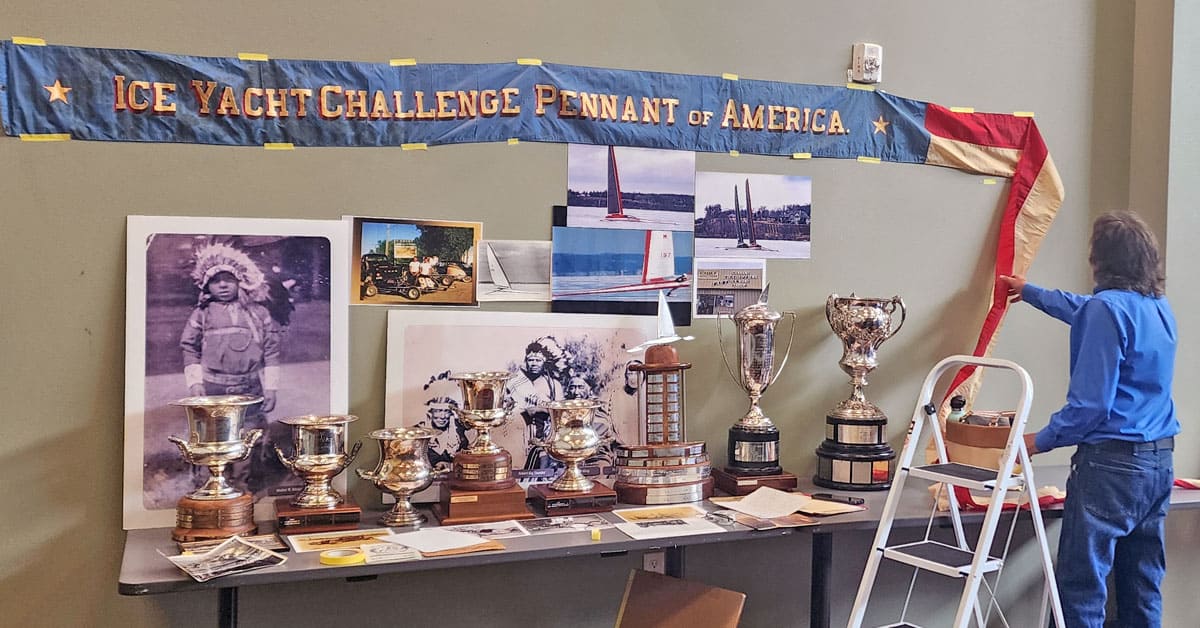
Ken Whitehorse adds the finishing touches to a display honoring the Whitehorse family’s legacy in iceboat and auto racing, featuring historic trophies and family photos.
Skeeter sailor Ken Whitehorse recently participated in an early-stage gathering hosted by Wisconsin Public Television for their upcoming documentary, Wisconsin Hometown Stories: Madison. The two-hour program will explore Madison’s history, focusing on Teejop — the Ho-Chunk name for this region, meaning “Four Lakes.”
WPT is working closely with members of the Ho-Chunk Nation to ensure their stories and perspectives are central to the project. WPT invited Ho-Chunk community members to share their memories of Madison during the event. Ken curated a presentation on the Whitehorse family’s deep involvement in iceboat and auto racing. He displayed several historic trophies — including the Ice Yacht Challenge Pennant, won by AJ Whitehorse in the 1980s — and noted, “Whitehorse names are all over these trophies.” It was a reminder of the family’s long-standing presence in Madison’s sporting culture. We were also blessed by the presence of Ken’s father, Walter Whitehorse — a longtime 4LIYC Skeeter sailor — who recently celebrated his 100th birthday.
A few days earlier, I also spoke with the producer about Madison’s iceboating history and shared memories of my late husband, Harry Whitehorse, whose legacy as an artist and iceboater continues to shape how we remember this place.
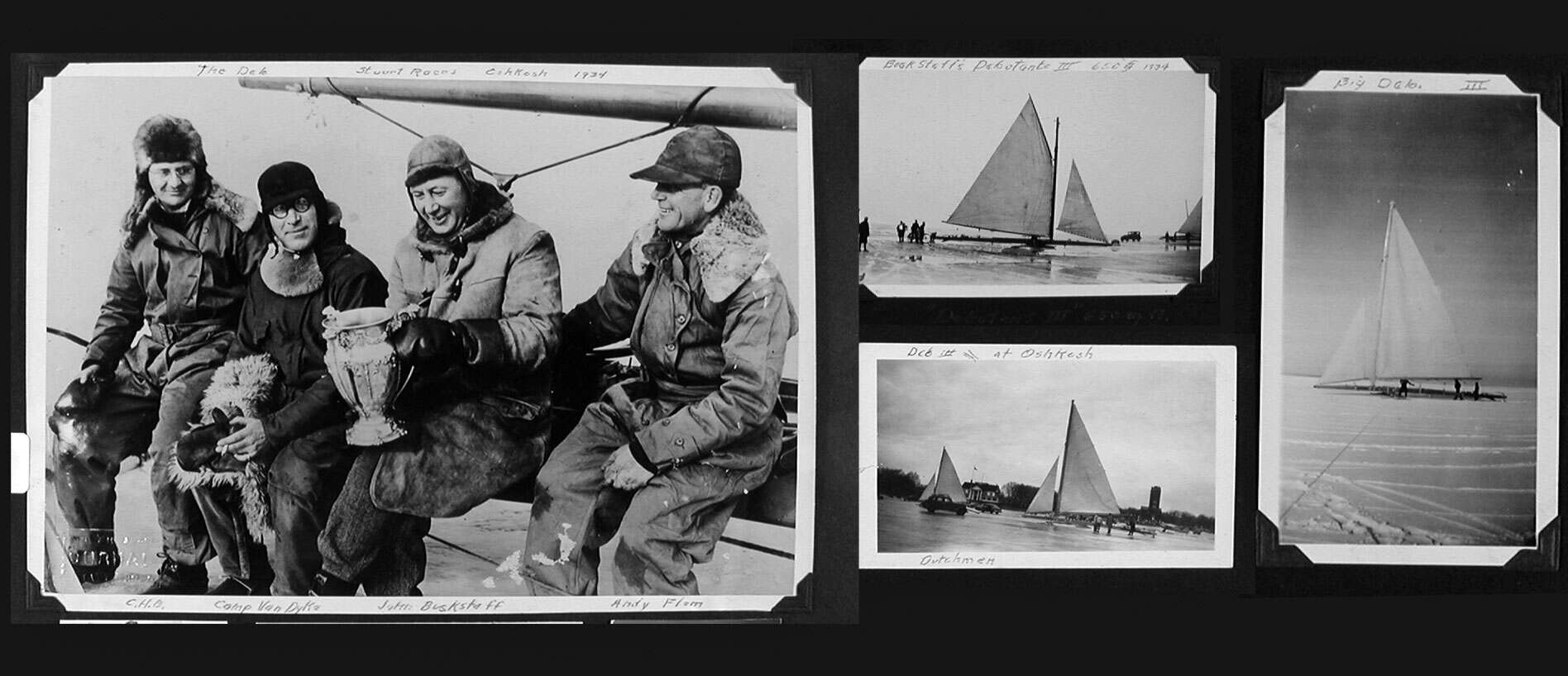
Photos of DEBUTANTE, built by George Buckhout, from the William and Carl Bernard scrapbooks.
Via Robert Willis:
Online Presentation: Ice Yachting Since its Beginnings in the Hudson River Valley
Date: May 16, 2025 Time: 5:30 – 6:30 PM Location:Antique Boat Museum Cox Auditorium & YouTube Live Presenter: Robert Willis, President, Hudson River Ice Yacht Preservation Trust Live Stream:YouTube Live Stream
From Dutch innovation to high-speed thrills on the Hudson, discover how ice yachts evolved from cargo carriers to the fastest vehicles on Earth. Mr. Willis takes us through the design, history, and enduring passion behind this unique winter sport.
This presentation is a good reminder that it all started in New York’s Hudson River Valley. Back in the day, “Northwestern” ice yachtsmen—our Midwestern forebears—knew that if you wanted the best, you went straight to the source: George Buckhout, the Valley’s most renowned builder of stern-steerers. Here’s more from Brian Reid about Buckhout and his legendary craftsmanship.
So when Oshkosh, Wisconsin’s own John Buckstaff—himself a giant in the iceboating world—wanted a top-tier Class A stern-steerer, he went to Buckhout. The result? DEBUTANTE—a fast, graceful, and fiercely competitive yacht that would become one of the most iconic stern-steerers in Wisconsin history.
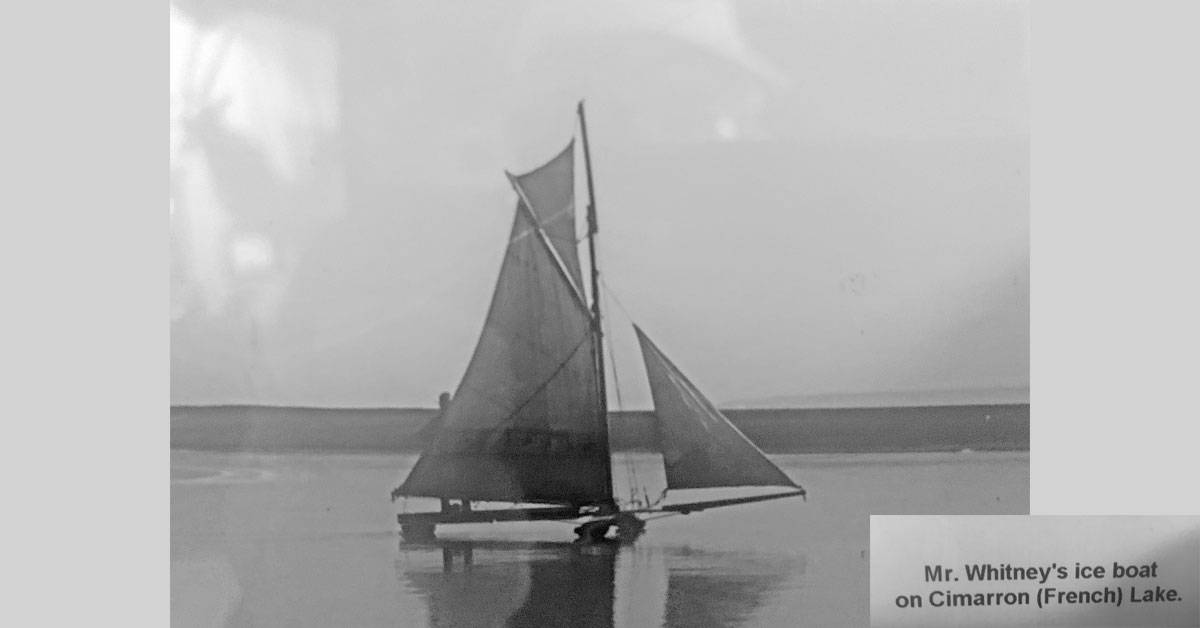
When 4LIYC Nite sailors Lars Barber and Brad Wagner hit the road for land or ice sailing events, they don’t just set the cruise control and blast down the highway. These two turn every road trip into a treasure hunt—stopping at flea markets, poking around small towns, and always keeping an eye out for something unusual. On their return from the 2025 Blokart North Americans, they pulled into a hotel in Cimarron, New Mexico—and sure enough, Lars spotted something unexpected: an old black-and-white photo of a stern steerer iceboat hanging on the wall with the caption: “Mr. Whitney’s ice boat on Cimmeron (French) Lake.”
New Mexico isn’t typically known for iceboating, but French Lake, situated in the Sangre de Cristo Mountains near Cimarron, is located at an elevation of about 6,300 feet. At this altitude, small lakes can freeze during the winter.
Using old newspaper and genealogy archives, I tracked down “Mr. Whitney.” He was Frederic Whitney, born in 1879 in Iowa. His father and ancestors were from Maine, so he possibly brought that knowledge with him when he moved west. During his time in New Mexico in the early 1900s, Whitney became a prominent local figure. One article even noted that he had installed a tennis court at his ranch, showing his passion for sports and outdoor life. Later in life, he moved to Alaska and died on the Kenai Peninsula in 1978 at 99.
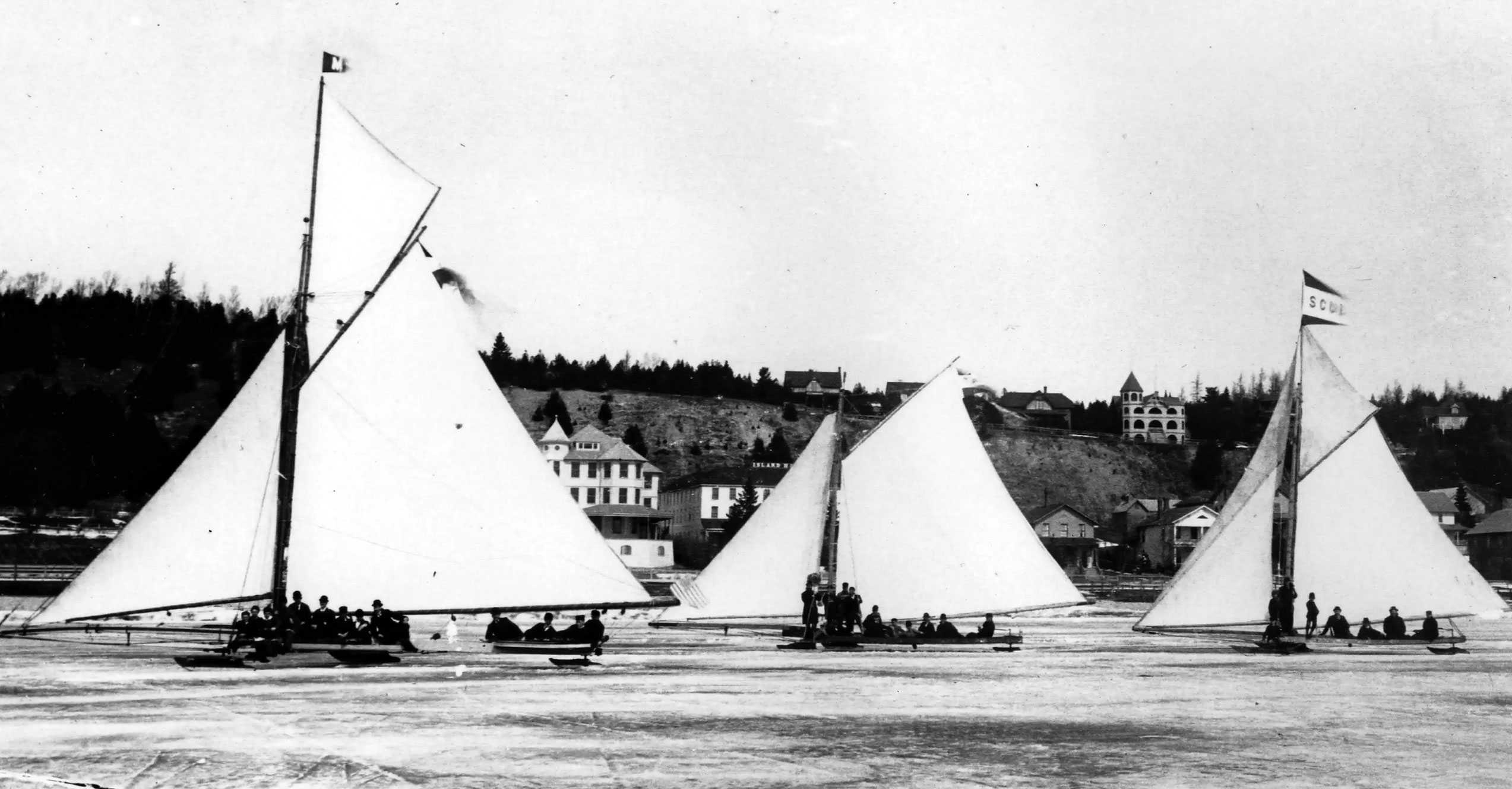
Though I couldn’t find any specific record of Whitney iceboating, I sent the photo to iceboating sailmaker and historian Henry Bossett to get his take. Henry pointed out that Mr. Whitney appears to be sailing while standing up—an unusual style. (Perhaps a windless day?) He also noted the rig features a jib-headed topsail, a small triangular sail used on gaff rigs and set between the gaff and the mast. In the sport’s early days, some iceboaters repurposed their summer sailing rigs and mounted them on iceboat frames. Henry shared a historical example of a similar setup, included below.
While we may never learn much more about Frederic Whitney’s brief moment on the ice at French Lake, it remains another interesting footnote in the unexpected history of ice sailing.
Staging the perfect shot back in the day —no filters, no drones, just a guy in a business suit on the ice and a camera.
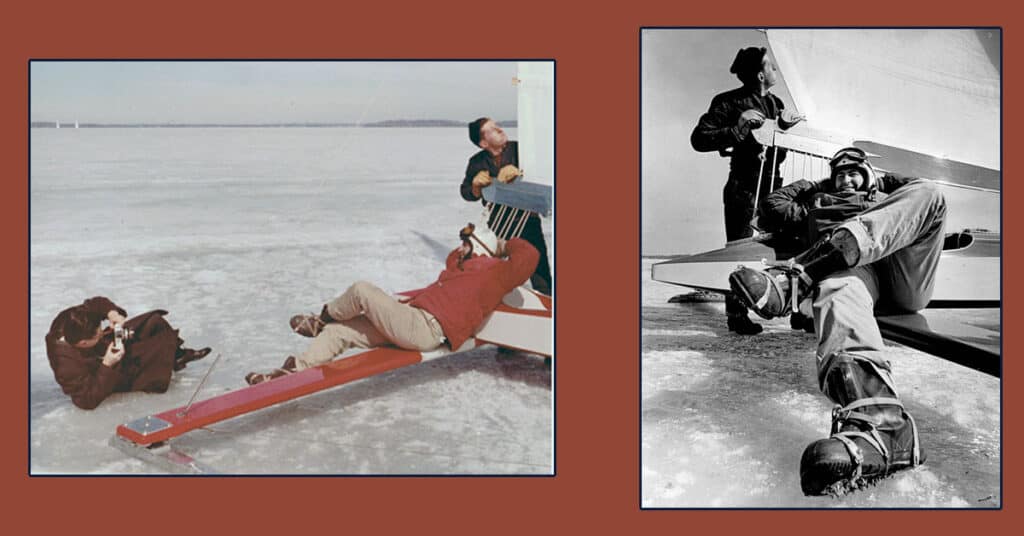
I recently visited with Mauretta Mattison and her daughter, Lynn. Mauretta handed over a box overflowing with iceboating memorabilia that she had meticulously collected over the years, detailing her late husband Bill’s and family’s extraordinary life on the ice. It’s a collection that could keep an iceboating historian busy for months. As I quickly flipped through it, two items caught my attention: a pair of photos capturing what looks to be a lazy, light-air day on the ice and another featuring Elmer Millenbach, the Renegade’s mastermind
The first photo is a behind-the-scenes look at a photo shoot on the ice. Wisconsin State Journal photographer Edward Stein is lying on his side, dressed in a business suit and dress shoes—no winter gear.. He’s aiming at Bill Mattison, relaxed on the runner plank of his Skeeter, with another guy peering up at the sail from behind the boom. Next to it in the scrapbook is the finished product—the photo Stein snapped that day, which ran in the Wisconsin State Journal.
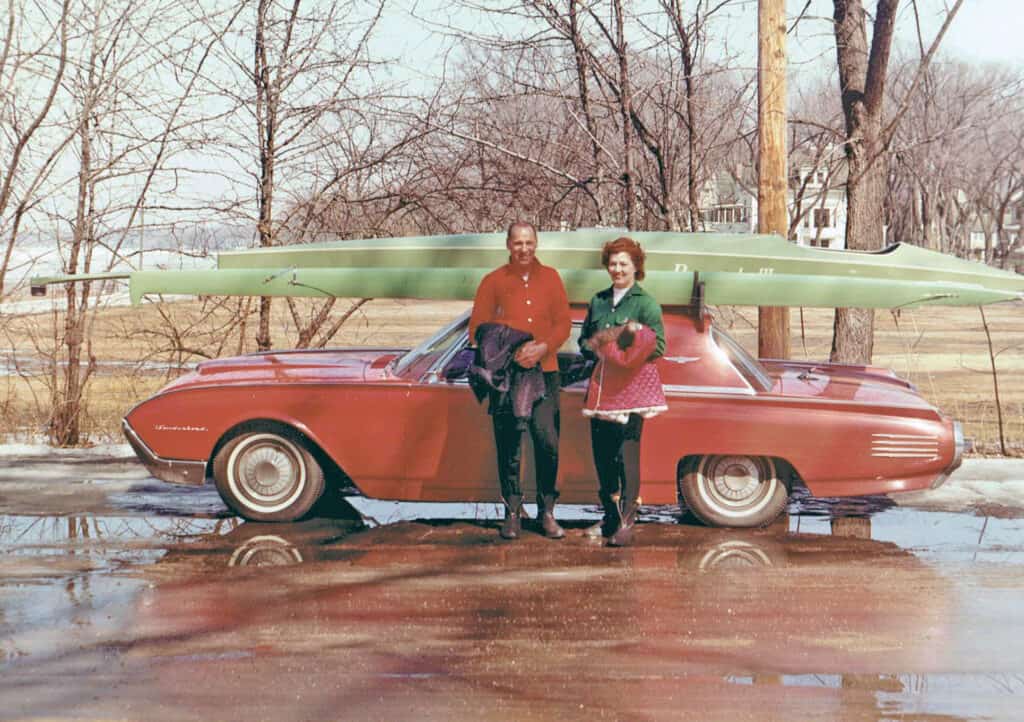
Then there’s a second photo that caught my eye—a classically cool image featuring Elmer Millenbach and his wife, Cora Lee, standing beside their Ford Thunderbird (possibly a 1964?) with Elmer’s Renegade on top of the car. Elmer, the Detroit innovator who designed the Renegade, was known for transporting his hull on top of cars instead of using a trailer. The Thunderbird is stylish match for the sleek lines of the Renegade.
Stay tuned as I dig deeper into this box of history.
Elmer and Cora Lee Millenbach have Fun Fun Fun cruising with style.
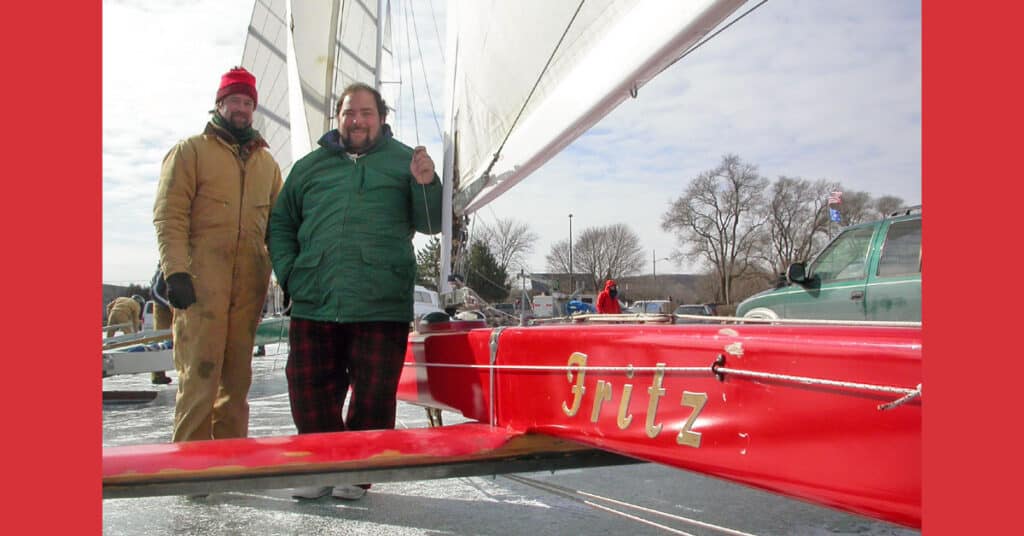
FRITZ ARCHIVES
After 25 years of stewardship, Fred Stritt has passed the helm of the historic Class A stern-steerer FRITZ to a new caretaker. The iconic iceboat, built by Carl Bernard, has found a new home on Lake Minnetonka in Minnesota.
Fred shared his thoughts on the transition on the Midwest Hardwater Sailing Facebook page:
FRITZ is an incredible machine—smooth in light air, exhilarating in medium air, and on the edge of terrifying in heavy air. She’s like hanging onto the tail of a dinosaur—if they want you gone, you’ll be flicked off and flying! Congratulations to Bill and his group and I look forward to seeing Fritz blossom under your guardianship!
Some History:
The Class A stern-steerer FRITZ, built by Carl Bernard, roared into iceboating legend as a Madison, Wisconsin icon. Owned by Frederick Jungbluth and sailed by Bernard, FRITZ achieved an extraordinary feat in 1934, winning all four major trophies—the Stuart Cup, Hearst International Trophy, Northwest Class A, and Northwest free-for-all—in a single year, a record unmatched at the time. FRITZ was a powerhouse, and her victories were celebrated in the Wisconsin State Journal and beyond.
Tragedy struck in 1935 when a mysterious fire—suspected to be arson—destroyed FRITZ and her companion, Miss Alice in Madison. Yet FRITZ endured, and Carl rebuilt her after the fire; she was painted bright red to honor her survival. By 1948, with Bill Mattison crewing for 18-year-old Jim Lunder, she reclaimed the Northwest Class A title on Geneva Lake. Please see the FRITZ archives for more history on this boat.
MARY B and FRITZ at the Edgewater on Lake Mendota,