The Community Rick Built
54′ of Fast: Link to Video

Rick Hennig’s nephew, Dave Elsmo, shares his thoughts about Rick below. Rick’s investment in Dave paid dividends. Dave has gone on to give countless of University of Wisconsin students their first iceboat rides and has brought many new sailors into the DN fleet.
Dave is also the videographer behind the video above, 54′ of Fast. When people ask me about iceboating, this is one of the first videos I show them. I’ve shared it countless times over the years.
Following Dave’s words, fellow stern-steerer sailor Dave Lallier, who understands what it takes to care for one of these historic boats, shares his thoughts about his friend Rick.
The Roots Rick Planted
Dave Elsmo
As the Greek proverb goes, “A society grows great when old men plant trees whose shade they know they shall never sit in.” In my moments of reflection over the past few days since Rick’s passing, this thought has kept coming back to me. I think it describes the man very well in all of his pursuits.Whether it was the soft-water programs, his cars, his iceboating, or his local community, Rick was always doing something that would inevitably benefit people he may never meet or live long enough to see impacted by his generosity. It didn’t matter. I’m not even sure that thought ever crossed his mind. He never seemed particularly interested in gaudy announcements proclaiming his involvement. If something needed doing or somebody needed help, he stepped in with his time and resources. The best of those resources was always the people he surrounded himself with. The Cabbage Patch crew was never far behind.
I remember coming back from college broke and lacking much motivation. Rick put me to work fairing the hull, plank, and mast of the DEUCE. Anybody looking at the boat would have said it was already perfect, but for days on end he kept coming back to me and another kid working with me, telling us to keep going. We were there until the boat was perfect — his version of perfect.
At the time, I knew nothing about iceboating, and I had no idea how profound the piece of equipment I was working on really was. I just knew the work was mind-numbing. While I piddled away with putty and sandpaper, Rick and a group of friends were building a wheelchair ramp for a friend’s family member. I didn’t fully digest it then, but he was doing it simply because it was the right thing to do and because someone he cared about had a need. It really was that simple and my job was to do the mind numbing stuff so he could do more important stuff.
I didn’t have much of a relationship with Rick in my younger years. I sailed casually around the local club and saw him here and there at family events. Then, out of the blue during the winter of my sophomore year at Minnesota, Rick called and told me he had picked up an iceboat from a friend and wanted me to have it and start racing. I knew absolutely nothing about the sport, but winters in Minneapolis were boring, so I picked it up one random weekend and waited for ice. A local friend from scow racing, Jim McDonagh, was an avid DN racer who told me about an event outside the Cities and said to just show up. I had no idea what I was doing. I had the boat, one wrench, and some fuel in the tank. I hit the ice, caught a puff, ripped off into a snow squall following Jim to the course, and never looked back.
The next summer, Rick told me to show up at a swap meet in Lake Geneva, so I made the trip. He had picked up a trailer from the Pegels, a mast and set of runners from Ron Sherry, and a new sail. His thinking was that with the trailer I could get more people onto the ice and that’s exactly what happened.
I scratched around for loaner boats and soon had four programs going to get others involved in the sport. Having travel partners made it financially possible for me to keep traveling, but more importantly, it helped grow the fleet.
As I fell deeper into the sport, Rick already had another plan. There was still a massive pile of Sitka spruce sitting in his shop from the DEUCE build, so he and the Cabbage Patch crew pumped out eight or ten sets of DN sideboards and started building. They got one hull started, which I picked up along with the rest of the sideboards, and I haven’t stopped building since.
I still laugh at the idea that the scraps from the DEUCE build were enough to create an entire flotilla of DNs. Today, every set of those boards is still in the fleet and racing. Young sailors who started in those loaner boats eventually built their first hulls from some of the best wood imaginable, all sharing the same genealogy as the DEUCE.
Many of the people who started iceboating and building with that wood eventually found their way onto Rick’s summer programs. Most of them are still racing together today because he took a chance on younger people. He brought the opportunities; we brought the bodies to sail boats that always seemed to get bigger and more terrifying to manage.
That brings me back to the DEUCE.
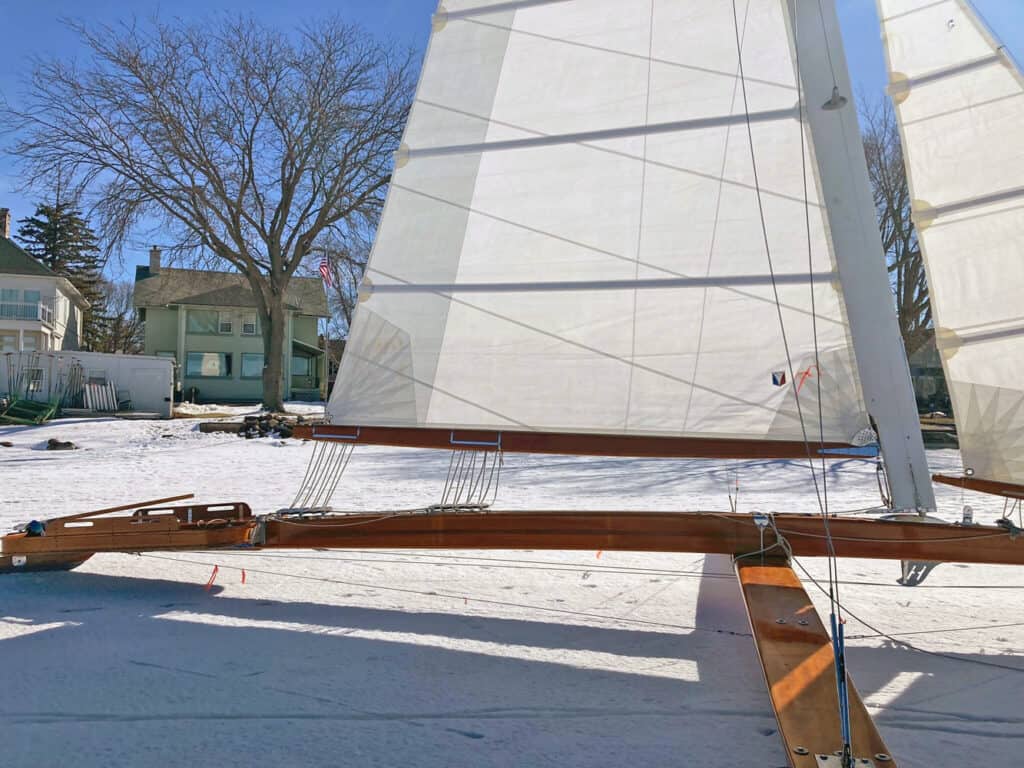
That boat is one hell of a program. When it leaves the shed, an army of people moves across the country to make sure there are enough hands to rig, enough bodies to rotate in for racing, and enough old-timers in the pits to keep everything safe, or at least as safe as it could be. Rick took care of all of them. He spent more time making sure everybody had what they needed than sailing. I had only taken a ride on the boat twice before Rick told me to take the tiller. I’m lucky I was wearing brown coveralls that day. Despite my concerns, a few of us from the Cabbage Patch crew went out for a spin. To this day, my hands still get sweaty thinking about that ride.
The men who (re)built these A-Class stern steerers were a different breed. They are unlike anything I see coming down the pipeline anytime soon. They are unreasonable, unruly, unpredictable, unnecessary, unwavering and at this point, I’m not sure whether I’m talking about the man or the boats now
Great men are compelled to do great things, especially when they are determined to preserve history while fostering new generations. Rebuilding the boat was a community event and sailing the boat is a community event. The boat was only the mechanism, community was the point all along.
This story is just one of hundreds that will emerge over the coming weeks as people find moments to reflect on a life well lived. Mine is only a small piece of a much larger story others may never know. I would challenge others to take a moment to write or reflect on their own experiences with Rick.
The thing about planting trees whose shade you’ll never sit in is that you never know where those roots reached. Rick likely never realized how many people he set in motion, how many friendships, programs, boats, and traditions grew from the opportunities he created. But that’s the mark of a great man. He planted anyway.
By Dave Elsmo


We Are All Just Caretakers
By Dave Lallier
I first met Rick when he brought the DEUCE to Lake Winnebago near my house. It must have been shortly after he acquired her, as he was still using cotton sails. I was fortunate to have had some great sails on her with Rick.At about the same time, my brother Jeff and I were in the middle of restoring the FLYING DUTCHMEN. Rick took great interest in the restoration, as he was doing the same with the DEUCE. We had many discussions regarding the work being done. Rick was aware that we would need a new runner plank and offered to help.
After the new backbone for the DEUCE was completed, he suggested that a new plank be built at his shop. My brother Jeff was working in Milwaukee at the time, so he traveled to Rick’s every evening to work on it. Rick had all the designs and methods in place, as well as the tools and wood for the job. As you can see today, the plank is a true work of art.
After the plank was done, I asked Rick where we should go to have new stays for the mast made. He told me to assemble the boat in our yard and that he would come help. He showed up with a large hydraulic swaging machine and a bunch of cable. That afternoon, the DUTCHMEN’s mast stood again with all new stays and adjuster tubes that Rick made.
I asked him where he got all that stainless cable. He smirked and said, “Watch the evening news because there may be some sailboat masts falling over in Racine.” We had a good chuckle.
If it hadn’t been for Rick, I’m not sure the DUTCHMEN would be sailing today. It takes special people to keep these large historic yachts sailing. It has been said many times that nobody really owns these boats; we are all just caretakers of them.
Rick called me in February 2025. I was sitting in my car on the ice near Fond du Lac, watching the awards being handed out for the Wisconsin Stern Steering Regatta. We had a wonderful talk. He told me he wished he could have brought the DEUCE, but couldn’t because he wasn’t feeling well. He didn’t tell me what was wrong, but I had a bad feeling. That was the last time we talked.
As has been said before, iceboaters are a very close family. Weeks, months, and sometimes years may pass before we see each other, but reunions feel like we were together just yesterday.
The greatest gift Rick gave me was his friendship.
Dave Lallier
Former caretaker, FLYING DUTCHMEN A8
I’d like to add one small story of my own because it says something about Rick’s lasting impact on ice sailing.
On the same day Rick passed away, I called my brother, Ron Rosten, to tell him the news. Ron paused and said, “Wow, that’s strange because I was just thinking about him.” Earlier that very day, a group of Four Lakes Ice Yacht Club sailors had been gathered in Damien Luyet’s shop cutting up some of the original Sitka spruce left over from the DEUCE project.
Even now, wood from Rick’s rebuilding of DEUCE is finding its way into new boats and new sailors’ hands. It felt like one more reminder that Rick’s influence on the sport is still moving forward – Deb