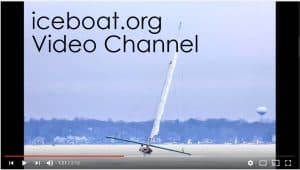
This season, major media outlets rediscovered ice sailing.
A few weeks ago, before the latest storm buried the East Coast in snow, strong ice and clear wind brought the Van Nostrand Challenge Cup back to the Navesink River in Red Bank. The historic race ignited a wave of attention. Reporters from The New York Times, The New Yorker, and NPR took notice of ice sailing. Historic iceboats and clubs filled social media feeds with photos and video. The audience expanded in a way we rarely see.
That attention helps recruit new sailors and preserve historic clubs whose traditions stretch back more than a century. It reminds the public that this is not a curiosity, but a serious winter sport with deep American roots and active fleets from Montana to Maine.
For decades, people have asked: why not the Olympics? In the late 1990s and early 2000s, there were formal discussions with the International Sailing Federation about bringing ice sailing into the Winter Games. Meetings were held. Surveys were conducted. A purpose-built Olympic ice yacht was even considered. The effort ultimately stalled, largely because the Olympics require certainty, and ice does not cooperate on a fixed schedule. Here’s an article about the situation with more detail in the DN Newsletter Runner Tracks: LINK
This season demonstrated that when conditions arrive in highly visible places, the story of the sport travels farther.
ice sailors never forget! Talk about patience, this is next level. Congratulations to the Hudson River crew on winning back the Van Nostrand Cup after 135 years and for keeping this remarkable piece of ice sailing history alive. And thank you to Red Bank Green, the independent local news outlet, for giving this regatta practically play by play and for their continuing coverage of ice sailing at Red Banks.
As the boat built by 19th-century architect Archibald Rogers came to a stop after their second straight win in the best of three, skipper Luke Lawrence and sheet tender Max Lopez exchanged hugs and gloved high fives with friends and family. One of several drones filming the action crashed into the sail and fell to the ice.
Then, Lawrence paused for a quiet emotional moment, kneeling silently in the basket amid the hoots and hubbub.
“I did this one for pop pop,” he said a few moments later, referring to his grandfather, Bob Lawrence, a boat builder and sailor. “He won a lot of stuff, but never this one. So this one is for him. Read more
Iceboats returned to the frozen Navesink River and Red Bank, New Jersey reacted like Taylor Swift was in town. Fences were treated as optional, everyone wanted a front-row view.
Our good friends at the historic North Shrewsbury Ice Boat and Yacht Club and the Hudson River Ice Yacht Club are back racing for a Tiffany silver cup first made in 1886, while the public presses toward the ice like it’s the pit at Madison Square Garden. When iceboats appear, winter suddenly has a main event.
RED BANK: ICE BOATING “AMERICA’S CUP” ON TAP, WITH WARNINGS By BRIAN DONOHUE
Stay out of the way of the ice boats. And stay off the construction site.
Those are the messages being sent by dual entities as Red Bank gets set to host the Van Nostrand Cup, an ice boat contest the NY Times in 2003 called possibly “the oldest and longest-deferred grudge match in sports history.”
For a second straight weekend, the frozen Navesink River is likely to draw not only ice boat race spectators to see it, but visitors looking to skate, frolic, or shoot selfies. Continue reading.
Earlier this week, NPR’s All Things Considered aired a short segment on ice sailing. I was invited to talk about the sport, how it works, why it is so fast, and some of the history.
While there is currently no sailing on the Four Lakes, the season itself is very much alive. The DN class is set to hold the DN North American Championship on Lake Wawasee in Indiana, with racing expected to begin Sunday, January 25. Follow along here: LINK
There’s even a webcam.
There are also early signs of other sites developing. Word on the street is that Green Lake has recently iced over and is worth watching as conditions evolve.
As I write this, it is –15°F, which is too cold to iceboat anyways, but not unusual for January, and not a reason to count the season out.
While we wait for Mother Nature’s super Zamboni to finish its work, with rain turning to snow over the next couple of days, there is time to look backward. A dive into the Daily Cardinal archives turned up an unexpected addition to Madison’s iceboating story.
The recent post about the UW student film Not Responsible led me into the University of Wisconsin newspaper The Daily Cardinal archives. While looking for references tied to the film, I started poking around more broadly to see what the paper had written about iceboating.
Iceboating appears in the Daily Cardinal from the late nineteenth century onward, and by the 1920s it was treated as routine winter life on campus. Boats were raced, rented, and rarely explained to readers. The paper assumed its audience already understood what iceboats were and how they fit into life on Lake Mendota.
One of the things I found along the way was a small but important addition to the Charles Lindbergh story in Madison.
For years, Lindbergh’s connection to iceboating here has been told through a story that centers on the motorized ice craft he helped build on Lake Mendota in 1921, powered by a motorcycle engine geared to an airplane propeller. That account is well documented, and it still stands.
What the Daily Cardinal archive adds is one more fact. In a 1929 article reflecting on Lindbergh’s Wisconsin years, the paper notes, without emphasis, that he owned an iceboat while he was a student. Iceboating was part of ordinary winter life on Lake Mendota at the time.
Lindbergh’s motorized iceboat looks like an extension of something he already understood well, speed on ice.
Family context helps explain why. Lindbergh’s maternal grandmother was a Lodge from Detroit, and his cousin Joe Lodge (part of the trio who designed the DN) was an active iceboater there. Detroit, like Madison, was a center of iceboating and mechanical experimentation in the early twentieth century. Iceboats there were not just raced but modified, tuned, and pushed. Lindbergh arrived in Madison already comfortable with machines, ice, and speed.
A later source adds more to Lindbergh’s connection to iceboating. In Evolution of Modern Sailboat Design, Meade Gougeon notes that Lindbergh is said to have assisted his cousin Joe Lodge with the design of a highly advanced rig installed on the Class A stern steerer DEUCE II in the mid 1930s. The boat featured a rotating wing mast believed to be the first of its kind. Although DEUCE II suffered repeated rigging failures, the concept carried forward, and Lodge went on to win the Stuart Cup and Hearst International Trophy in 1938 with the rebuilt DEUCE III. The account suggests that Lindbergh’s interest in iceboating did not end in Madison, but extended into later experimentation at the highest level of the sport.
Daily Cardinal, February 22, 1929
Joe Lodge, holding an iceboat runner, with Fritz Jungbluth in Detroit, 1937. Lodge was a cousin of Charles Lindbergh. Photo from the Bernard scrapbook collection.
Motorized iceboat likely powered by a Ford Model T engine. This is a separate experiment from Lindbergh’s motorized ice craft.