While we wait for Mother Nature’s super Zamboni to finish its work, with rain turning to snow over the next couple of days, there is time to look backward. A dive into the Daily Cardinal archives turned up an unexpected addition to Madison’s iceboating story.
The recent post about the UW student film Not Responsible led me into the University of Wisconsin newspaper The Daily Cardinal archives. While looking for references tied to the film, I started poking around more broadly to see what the paper had written about iceboating.
Iceboating appears in the Daily Cardinal from the late nineteenth century onward, and by the 1920s it was treated as routine winter life on campus. Boats were raced, rented, and rarely explained to readers. The paper assumed its audience already understood what iceboats were and how they fit into life on Lake Mendota.
One of the things I found along the way was a small but important addition to the Charles Lindbergh story in Madison.
For years, Lindbergh’s connection to iceboating here has been told through a story that centers on the motorized ice craft he helped build on Lake Mendota in 1921, powered by a motorcycle engine geared to an airplane propeller. That account is well documented, and it still stands.
What the Daily Cardinal archive adds is one more fact. In a 1929 article reflecting on Lindbergh’s Wisconsin years, the paper notes, without emphasis, that he owned an iceboat while he was a student. Iceboating was part of ordinary winter life on Lake Mendota at the time.
Lindbergh’s motorized iceboat looks like an extension of something he already understood well, speed on ice.
Family context helps explain why. Lindbergh’s maternal grandmother was a Lodge from Detroit, and his cousin Joe Lodge (part of the trio who designed the DN) was an active iceboater there. Detroit, like Madison, was a center of iceboating and mechanical experimentation in the early twentieth century. Iceboats there were not just raced but modified, tuned, and pushed. Lindbergh arrived in Madison already comfortable with machines, ice, and speed.
A later source adds more to Lindbergh’s connection to iceboating. In Evolution of Modern Sailboat Design, Meade Gougeon notes that Lindbergh is said to have assisted his cousin Joe Lodge with the design of a highly advanced rig installed on the Class A stern steerer DEUCE II in the mid 1930s. The boat featured a rotating wing mast believed to be the first of its kind. Although DEUCE II suffered repeated rigging failures, the concept carried forward, and Lodge went on to win the Stuart Cup and Hearst International Trophy in 1938 with the rebuilt DEUCE III. The account suggests that Lindbergh’s interest in iceboating did not end in Madison, but extended into later experimentation at the highest level of the sport.
Daily Cardinal, February 22, 1929
Joe Lodge, holding an iceboat runner, with Fritz Jungbluth in Detroit, 1937. Lodge was a cousin of Charles Lindbergh. Photo from the Bernard scrapbook collection.
Motorized iceboat likely powered by a Ford Model T engine. This is a separate experiment from Lindbergh’s motorized ice craft.
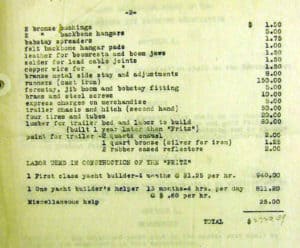
FRITZ ARCHIVES
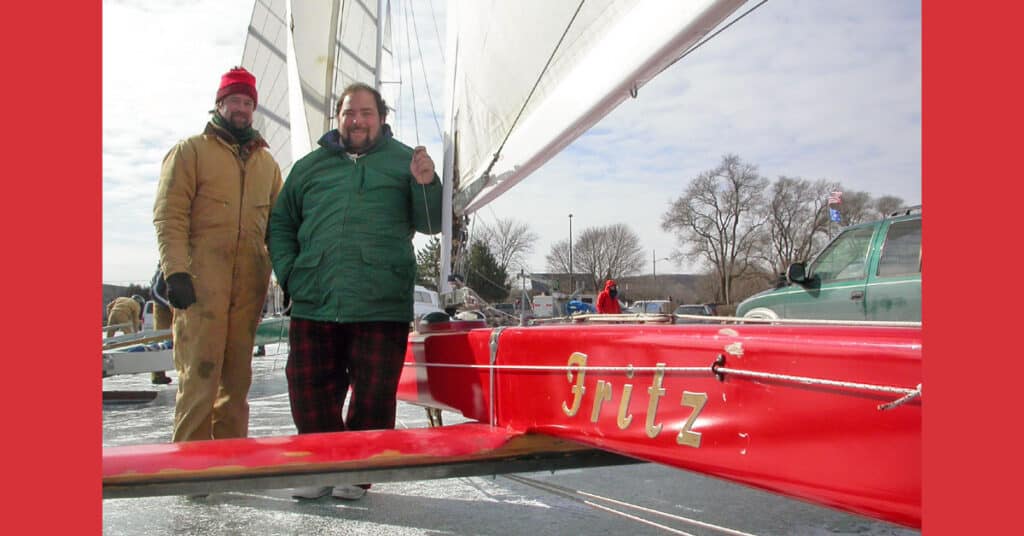
After 25 years of stewardship, Fred Stritt has passed the helm of the historic Class A stern-steerer FRITZ to a new caretaker. The iconic iceboat, built by Carl Bernard, has found a new home on Lake Minnetonka in Minnesota.
Fred shared his thoughts on the transition on the Midwest Hardwater Sailing Facebook page:
FRITZ is an incredible machine—smooth in light air, exhilarating in medium air, and on the edge of terrifying in heavy air. She’s like hanging onto the tail of a dinosaur—if they want you gone, you’ll be flicked off and flying! Congratulations to Bill and his group and I look forward to seeing Fritz blossom under your guardianship!
Some History:
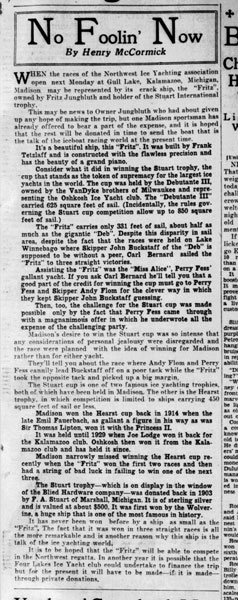
The Class A stern-steerer FRITZ, built by Carl Bernard, roared into iceboating legend as a Madison, Wisconsin icon. Owned by Frederick Jungbluth and sailed by Bernard, FRITZ achieved an extraordinary feat in 1934, winning all four major trophies—the Stuart Cup, Hearst International Trophy, Northwest Class A, and Northwest free-for-all—in a single year, a record unmatched at the time. FRITZ was a powerhouse, and her victories were celebrated in the Wisconsin State Journal and beyond.
Tragedy struck in 1935 when a mysterious fire—suspected to be arson—destroyed FRITZ and her companion, Miss Alice in Madison. Yet FRITZ endured, and Carl rebuilt her after the fire; she was painted bright red to honor her survival. By 1948, with Bill Mattison crewing for 18-year-old Jim Lunder, she reclaimed the Northwest Class A title on Geneva Lake. Please see the FRITZ archives for more history on this boat.
MARY B and FRITZ at the Edgewater on Lake Mendota,
An old windowsill from Madison house remodel leads to an iceboating story posted on the Madison Trust for Historic Preservation website.
Previous: 1934 Northwest Regatta
By Don Sanford
Ask any Madison iceboater if they know who Frank Tetzlaff is, you’ll get an earful. They’ll probably bend your ears for hours about two revolutionary iceboats he designed—the Fritz and the Mary B. In 1930, Frank established himself as one of the foremost iceboat designers in the Midwest when he designed and built the 38-foot Class A[1] stern steerer iceboat, the Fritz, for Madison iceboater and furniture dealer Fritz Jungbluth. The Fritz was a work of art and radically different from her contemporaries. But in iceboats beauty is only skin deep. It’s speed that counts and the Fritz was fast–real fast, winning regatta after regatta, bringing honor to her owner and hometown. Continue reading.
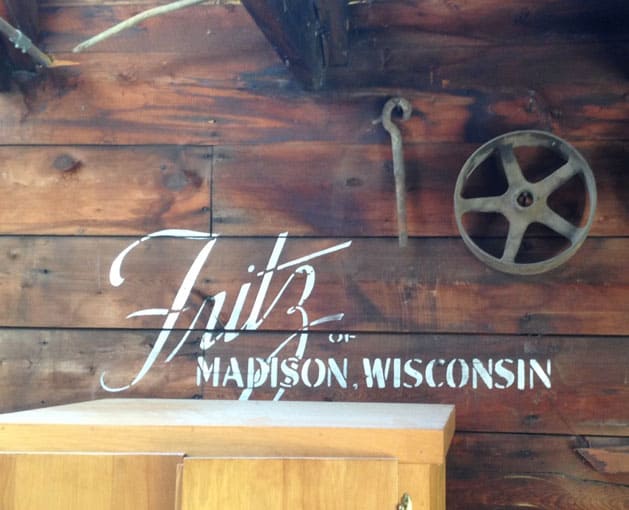
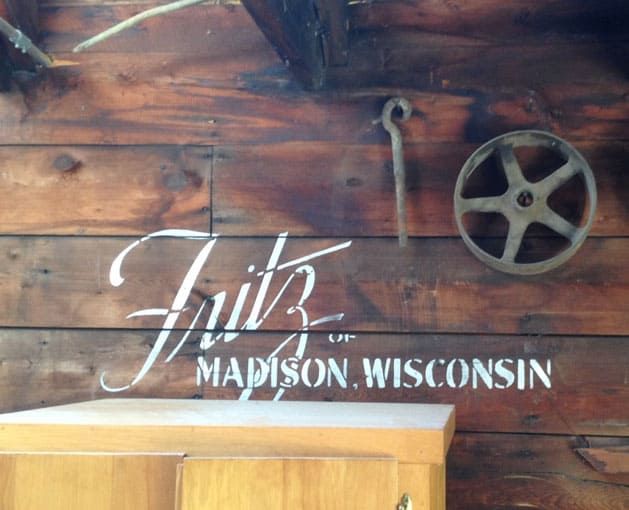
Madison’s iceboating history is all around if you know where to look. The FRITZ is still remembered at the former Bernard Boathouse on Gorham St. on Lake Mendota.
1934 Northwest
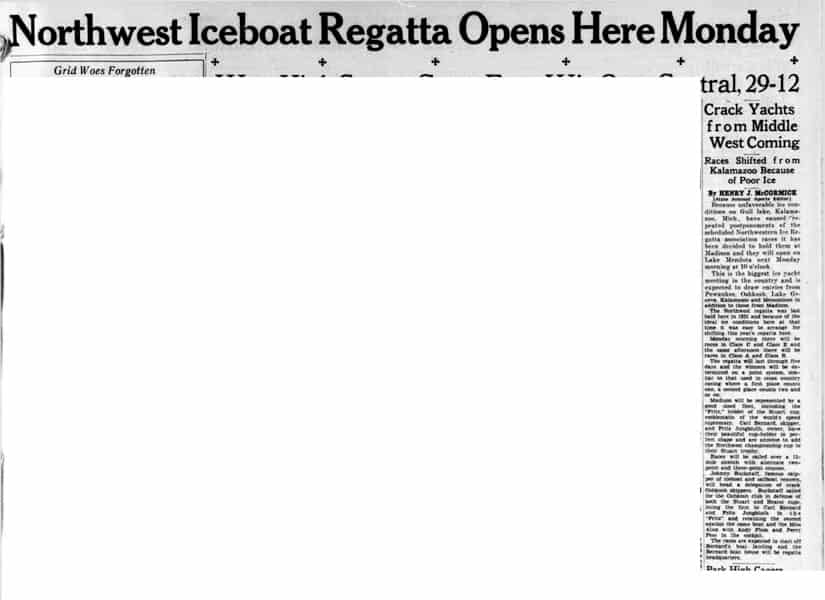
In the mid 1930s, stern steerers were still the only class that sailed in the Northwest. The 1934 Northwest A class title was captured by the Four Lakes Ice Yacht Club FRITZ, a boat built by Frank Tetzlaff, owned by Fritz Jungbluth, and piloted that year by Carl Bernard. The boat would go on to win the Northwest A Stern Steerer title for a total of 7 times. There’s enough history about this boat for a book to be written. Here are some articles about that regatta and links to some history. Apologies for not having the time this morning to write a more deserving in depth report on this boat.