Some people just can’t get enough of what iceboating brings.
The waiting for weather to cooperate. The endless discussions about runners (tires in this case), alignment, wood, ice (dirt), and speed. The camaraderie that comes from chasing conditions with friends who understand why any of this matters in the first place.
Several ice sailors, including 4liyc Renegader Damien Luyet, 4liyc sails-one-of-everything Daniel Hearn, DN Champ Ron Sherry, DN and Skeeter sailor Leon Lebeau, DNers Pete Johns, Ken Smith, Tim Ballard, and long time Montana dirt and ice sailors John and Scott Eisenlohr, and likely others I’ve missed, arrived near Winnemucca, Nevada yesterday for land sailing at the Jungo Yacht Club playa.
But Mother Nature had other ideas.
Rain turned the playa into an actual lake and served as a reminder that a dry lake bed is still a lake when enough water shows up. Photos from the scene looked more like an iceboat regatta venue than a land sailing site.
The good news is that desert conditions usually work fast. If the weather cooperates, the standing water should dry quickly and could leave behind the dirt equivalent of Hollywood ice. Maybe “Hollywood dirt.”
Sailors spent the lay day camped out in motorhomes, swapping stories and waiting for the playa to come back to life. Reports this morning suggest they’ve now found a way into camp and may be racing soon.
Hopefully we’ll be getting more reports from the gang out west as the playa dries and the wheels finally start turning.
Last year, Mauretta Mattison generously donated the Mattison photo archives to the Four Lakes Ice Yacht Club. Well, technically to me, because somehow I’ve become the person people send these things to. I’m glad to have them gathered in one place.
Given that Bill and Mauretta owned Star Photo and spent years in the photo developing business, the archive is extensive. Bill and Mauretta photographed everything, and we’re fortunate they did. There are boxes upon boxes of prints, negatives, and snapshots of iceboating life. It’s time to start digging through them and sharing some of the more interesting finds.
The first photo that caught my eye features another kind of classic American engineering: heavy Detroit iron. Back when cars like this early 1950s Ford hardtop, likely equipped with Ford’s Flathead V8, ruled the roads and hauled iceboats to the lake without complaint.
I believe this photo was taken at John “Pop” Bluell’s house near Yahara Place, though Jerry Simon will probably correct me if I’m wrong.
Fortunately, either Bill or Mauretta labeled the photograph. From left to right: John Bluell Jr. “Johnny,” John Bluell Sr. “Pop,” Herb Krogman “Herbie,” Dave Rosten (my father), and Bill Mattison.
You can almost reconstruct the scene, one still played out today, though the trailer may now be enclosed. The gang gathers at Pop Bluell’s house on a cold morning, loading hulls, spars, and runners onto the trailer and roof rack before heading off either to a regatta or simply out onto Mendota.
This photo is another reminder of how ordinary iceboating once was, and still is, around Madison.
Rick Hennig’s nephew, Dave Elsmo, shares his thoughts about Rick below. Rick’s investment in Dave paid dividends. Dave has gone on to give countless of University of Wisconsin students their first iceboat rides and has brought many new sailors into the DN fleet.
Dave is also the videographer behind the video above, 54′ of Fast. When people ask me about iceboating, this is one of the first videos I show them. I’ve shared it countless times over the years.
Following Dave’s words, fellow stern-steerer sailor Dave Lallier, who understands what it takes to care for one of these historic boats, shares his thoughts about his friend Rick.
The Roots Rick Planted Dave Elsmo
As the Greek proverb goes, “A society grows great when old men plant trees whose shade they know they shall never sit in.” In my moments of reflection over the past few days since Rick’s passing, this thought has kept coming back to me. I think it describes the man very well in all of his pursuits.
Whether it was the soft-water programs, his cars, his iceboating, or his local community, Rick was always doing something that would inevitably benefit people he may never meet or live long enough to see impacted by his generosity. It didn’t matter. I’m not even sure that thought ever crossed his mind. He never seemed particularly interested in gaudy announcements proclaiming his involvement. If something needed doing or somebody needed help, he stepped in with his time and resources. The best of those resources was always the people he surrounded himself with. The Cabbage Patch crew was never far behind.
I remember coming back from college broke and lacking much motivation. Rick put me to work fairing the hull, plank, and mast of the DEUCE. Anybody looking at the boat would have said it was already perfect, but for days on end he kept coming back to me and another kid working with me, telling us to keep going. We were there until the boat was perfect — his version of perfect.
At the time, I knew nothing about iceboating, and I had no idea how profound the piece of equipment I was working on really was. I just knew the work was mind-numbing. While I piddled away with putty and sandpaper, Rick and a group of friends were building a wheelchair ramp for a friend’s family member. I didn’t fully digest it then, but he was doing it simply because it was the right thing to do and because someone he cared about had a need. It really was that simple and my job was to do the mind numbing stuff so he could do more important stuff.
I didn’t have much of a relationship with Rick in my younger years. I sailed casually around the local club and saw him here and there at family events. Then, out of the blue during the winter of my sophomore year at Minnesota, Rick called and told me he had picked up an iceboat from a friend and wanted me to have it and start racing. I knew absolutely nothing about the sport, but winters in Minneapolis were boring, so I picked it up one random weekend and waited for ice. A local friend from scow racing, Jim McDonagh, was an avid DN racer who told me about an event outside the Cities and said to just show up. I had no idea what I was doing. I had the boat, one wrench, and some fuel in the tank. I hit the ice, caught a puff, ripped off into a snow squall following Jim to the course, and never looked back.
The next summer, Rick told me to show up at a swap meet in Lake Geneva, so I made the trip. He had picked up a trailer from the Pegels, a mast and set of runners from Ron Sherry, and a new sail. His thinking was that with the trailer I could get more people onto the ice and that’s exactly what happened.
I scratched around for loaner boats and soon had four programs going to get others involved in the sport. Having travel partners made it financially possible for me to keep traveling, but more importantly, it helped grow the fleet.
As I fell deeper into the sport, Rick already had another plan. There was still a massive pile of Sitka spruce sitting in his shop from the DEUCE build, so he and the Cabbage Patch crew pumped out eight or ten sets of DN sideboards and started building. They got one hull started, which I picked up along with the rest of the sideboards, and I haven’t stopped building since.
I still laugh at the idea that the scraps from the DEUCE build were enough to create an entire flotilla of DNs. Today, every set of those boards is still in the fleet and racing. Young sailors who started in those loaner boats eventually built their first hulls from some of the best wood imaginable, all sharing the same genealogy as the DEUCE.
Many of the people who started iceboating and building with that wood eventually found their way onto Rick’s summer programs. Most of them are still racing together today because he took a chance on younger people. He brought the opportunities; we brought the bodies to sail boats that always seemed to get bigger and more terrifying to manage.
That brings me back to the DEUCE.
That boat is one hell of a program. When it leaves the shed, an army of people moves across the country to make sure there are enough hands to rig, enough bodies to rotate in for racing, and enough old-timers in the pits to keep everything safe, or at least as safe as it could be. Rick took care of all of them. He spent more time making sure everybody had what they needed than sailing. I had only taken a ride on the boat twice before Rick told me to take the tiller. I’m lucky I was wearing brown coveralls that day. Despite my concerns, a few of us from the Cabbage Patch crew went out for a spin. To this day, my hands still get sweaty thinking about that ride.
The men who (re)built these A-Class stern steerers were a different breed. They are unlike anything I see coming down the pipeline anytime soon. They are unreasonable, unruly, unpredictable, unnecessary, unwavering and at this point, I’m not sure whether I’m talking about the man or the boats now
Great men are compelled to do great things, especially when they are determined to preserve history while fostering new generations. Rebuilding the boat was a community event and sailing the boat is a community event. The boat was only the mechanism, community was the point all along.
This story is just one of hundreds that will emerge over the coming weeks as people find moments to reflect on a life well lived. Mine is only a small piece of a much larger story others may never know. I would challenge others to take a moment to write or reflect on their own experiences with Rick.
The thing about planting trees whose shade you’ll never sit in is that you never know where those roots reached. Rick likely never realized how many people he set in motion, how many friendships, programs, boats, and traditions grew from the opportunities he created. But that’s the mark of a great man. He planted anyway.
By Dave Elsmo
We Are All Just Caretakers
By Dave Lallier
I first met Rick when he brought the DEUCE to Lake Winnebago near my house. It must have been shortly after he acquired her, as he was still using cotton sails. I was fortunate to have had some great sails on her with Rick.
At about the same time, my brother Jeff and I were in the middle of restoring the FLYING DUTCHMEN. Rick took great interest in the restoration, as he was doing the same with the DEUCE. We had many discussions regarding the work being done. Rick was aware that we would need a new runner plank and offered to help.
After the new backbone for the DEUCE was completed, he suggested that a new plank be built at his shop. My brother Jeff was working in Milwaukee at the time, so he traveled to Rick’s every evening to work on it. Rick had all the designs and methods in place, as well as the tools and wood for the job. As you can see today, the plank is a true work of art.
After the plank was done, I asked Rick where we should go to have new stays for the mast made. He told me to assemble the boat in our yard and that he would come help. He showed up with a large hydraulic swaging machine and a bunch of cable. That afternoon, the DUTCHMEN’s mast stood again with all new stays and adjuster tubes that Rick made.
I asked him where he got all that stainless cable. He smirked and said, “Watch the evening news because there may be some sailboat masts falling over in Racine.” We had a good chuckle.
If it hadn’t been for Rick, I’m not sure the DUTCHMEN would be sailing today. It takes special people to keep these large historic yachts sailing. It has been said many times that nobody really owns these boats; we are all just caretakers of them.
Rick called me in February 2025. I was sitting in my car on the ice near Fond du Lac, watching the awards being handed out for the Wisconsin Stern Steering Regatta. We had a wonderful talk. He told me he wished he could have brought the DEUCE, but couldn’t because he wasn’t feeling well. He didn’t tell me what was wrong, but I had a bad feeling. That was the last time we talked.
As has been said before, iceboaters are a very close family. Weeks, months, and sometimes years may pass before we see each other, but reunions feel like we were together just yesterday.
The greatest gift Rick gave me was his friendship.
Dave Lallier
Former caretaker, FLYING DUTCHMEN A8
I’d like to add one small story of my own because it says something about Rick’s lasting impact on ice sailing.
On the same day Rick passed away, I called my brother, Ron Rosten, to tell him the news. Ron paused and said, “Wow, that’s strange because I was just thinking about him.” Earlier that very day, a group of Four Lakes Ice Yacht Club sailors had been gathered in Damien Luyet’s shop cutting up some of the original Sitka spruce left over from the DEUCE project.
Even now, wood from Rick’s rebuilding of DEUCE is finding its way into new boats and new sailors’ hands. It felt like one more reminder that Rick’s influence on the sport is still moving forward – Deb
One more ride with Rick Hennig aboard the mighty DEUCE. Fair winds to a giant of ice sailing. Link to Video
Rick Hennig passed away after a long illness on Friday, May 15, and the ice sailing community has lost a giant of a man who sailed a giant of a boat.
Rick Hennig came to define the world’s largest stern-steerer, DEUCE. Rick didn’t originally build DEUCE, but over time the boat and the man became inseparable. Towering in stature and personality, Rick seemed born to handle the wheel of a machine like that.
In 2005, Rick spearheaded the effort to build a new hull for DEUCE. Looking back now, it was about far more than rebuilding a boat. Rick brought together ice sailors from across the Midwest. Everyone showed up, and the project became a gathering point for the community itself. I realize now how important that was.
Rick was equally at home on soft water. He raced and won in some of the Great Lakes’ classic distance races, including the Chicago to Mackinac and Port Huron to Mackinac.
What also stood out about Rick was the respect he showed to the elders of ice sailing. He always honored the people who passed on their knowledge to him, especially Bill Mattison and the Pegel family, whose influence on DEUCE and stern-steerer history he never forgot.
I know many of you sailed with Rick, built with him, raced against him, or shared time in the shop, at regattas, and around DEUCE. If you have a memory, story, or photo, please share it in the comments or send me a message. I would like to include your recollections in a longer remembrance of Rick’s life.
There will be more to come in the next few days, including memories from Rick’s family and friends.
Rick was a passionate guy on the sport of sailing, whether it be water or Ice. Someone who cared about the right to do in life, never taking a shortcut, always there for you to to lend a hand & solve problems. Hauling out of Racine WI, Rick was a lifelong, competitive sailor and a good one at that. Most people here at iceboat.org remember Rick as the proud owner of the Deuce and who did a beautiful job of rebuilding her. What I remember most was his love of sailing / racing his soft-water keel boats, winning prestigious races as the Chicago Mac, Trans-Superior, Queen’s Cup, & Hook races. He enriched and taught many sailors crewing for him on the various boats 60’-70’ he owned and campaigned through the years. His boats were always the best-maintained, and he took pride in that. He valued and appreciated friendship and those around him; he was generous, well-liked, and respected. Our community lost a good one. Smooth Sailing
Eric Jones
Our condolences to the Boston family on the passing of William “Spike” Boston. Obituary
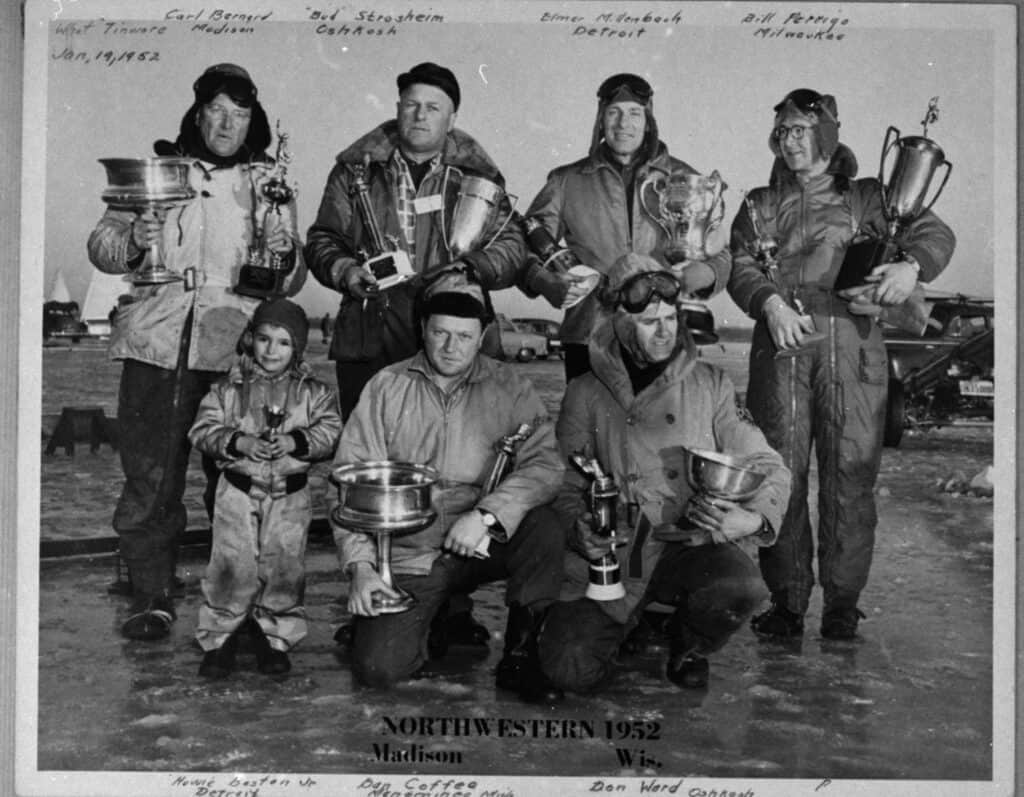
Spike was part of iceboating’s well-known Boston family of sailmakers, long connected to the sport. In the 1950s, his family built a scaled-down skeeter called PINK PINK. It wasn’t a toy, but a real iceboat, proportioned like the big boats. It wasn’t a full-sized racer, but one of the most memorable Skeeters of its time.
The short clip above shows him as a boy with the boat at the 1952 Northwest regatta sailed on Lake Monona. The photos that follow place it in context. Pink Pink alongside Ferdinand the Bull, the big stern steerer. The boat at the 1952 Northwest Regatta. And Spike standing with the winners, small among them.
BULL & PINK PINK, the Boston family mini-Skeeter on Lake St. Clair in Detroit
Spike Boston’s miniature Skeeter, PINK PINK
1952 Northwest Winners. I believe this may be Spike in the front row.
From Yachting World
By Toby Heppell
April 30, 2026
To understand what happened in Red Bank, New Jersey, in the first 10 days of February this year, you first have to understand the cold.
This wasn’t a regular winter. This was a freeze for the ages. A polar vortex settled over the US North-east like it had nowhere else to be, sending wind chills plunging to 20 below zero and locking waterways in ice that hadn’t been this thick in decades.
The Hudson River froze. The East River froze. New York Harbour froze. NYC Ferry suspended all routes. The Seastreak ferry – a lifeline for Jersey Shore commuters heading to Manhattan – needed a tugboat to crush a path through the ice in front of it just to make its daily run to the city.
Rivers that normally flow became roads. Bays that normally ripple became glass. The Navesink – the wide, tidal river that curls through Red Bank like a signature – became something it hadn’t been in over 20 years: a frozen stage for the oldest trophy race in American ice yachting. Continue reading.



 Rick Hennig passed away after a long illness on Friday, May 15, and the ice sailing community has lost a giant of a man who sailed a giant of a boat.