by Deb Whitehorse | Jul 29, 2022 | 2022-2023, Home Page

Iceboat Race Committee
Previous: Mystic Arrow
Mystic Seaport Museum Facebook Page
In conjunction with their current exhibition, Story Boats, Mystic Seaport Museum is hosting a virtual presentation about ice sailing on Thursday, August 4, 2022, at 1 PM CT/2 PM ET. From Stern-Steerers to Skeeters, Henry Bossett and I will discuss the roots, social history, and development of North American ice sailing. Henry is a DN class champion and retired sailmaker who has spent years combing through newspaper and museum archives finding the stories that define our sport.
Let’s cool off
Ice boating experts, Deb Whitehorse and Henry Bossett, will discuss the sport of ice sailing on August 4, at 2:00 PM ET in a free virtual presentation.
Click here to register: http://ow.ly/EHL550K1uEg
Like this:
Like Loading...
by Deb Whitehorse | Jun 27, 2022 | 2021-2022, Home Page

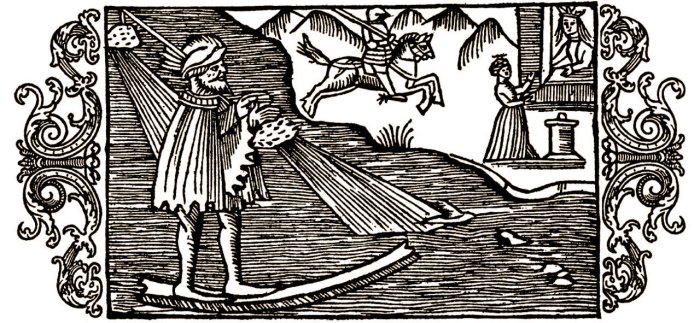
World’s earliest wind surfer? “Ollerus traverses the sea on his magic bone. 16th-century woodcut. Olaus Magnus, “Historia de gentibus septentrionalibus.”
Summer Solstice is behind us; we are on course for the next ice sailing season. Nordic countries have marked Midsommer since Pagan times when Thor and Odin ruled the north. I stumbled upon Ull, a Norse God who was the fastest deity around and patron of our favorite time of year. Ull could transform the shield he carried into a boat and bones into skates. With that much power, it’s not a stretch to believe his bow was basically a mast. Put his boat, bone skates, and mast together, and that’s an iceboat. In some Norse mythology accounts, Ull married Skadi, the Goddess of winter and cold. It’s five months until the Western Challenge, the season’s first fun DN regatta. Sharpen those bones!

Paul Krueger’s Class A Skeeter on Lake Monona, March 2022.
Like this:
Like Loading...
by Deb Whitehorse | Jun 20, 2022 | 2021-2022, Home Page, NIYA, WSSA

Carl Bernard, Camp Van Dyke, John Buckstaff, and Andy Flom sitting on the DEBUTANTE on Lake Winnebago in 1934. John Buckstaff is holding the Stuart Cup.
John Buckstaff Archives
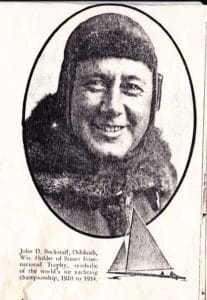
If iceboating had a hall of fame, Lake Winnebago sailor, John Buckstaff would undoubtedly be among the first to be nominated. Buckstaff’s Oshkosh roots go back to his grandfather, who was born in 1799 and came from New Brunswick, Canada, to Oshkosh in 1850 and started a sawmill.
An early mention of Buckstaff in the Oshkosh Daily Northwestern newspaper was in 1903, when he was 14 years old and recognized as a skilled scow sailor. “His first experience was gained, when as a boy in knickerbockers, he constructed an iceboat and sailed it on the frozen surface of Lake Winnebago. Here he learned to be quick and certain with the tiller and to handle the sail and tack.”
Buckstaff was in Menominee, Michigan, when the Menominee, Marinette, Wisconsin, and Oshkosh ice yacht clubs formed Northwest Ice Yachting Association in 1913. The morning after a banquet at the Hotel Menominee, where 200 ice yachtsmen gathered for a feast, they organized the Northwest, which they patterned after the Inland Lake Yachting Association, a soft-water scow regatta still going strong today.
In addition to his Northwest victories, Buckstaff won two prestigious stern-steerer titles, the Stuart and Hearst Cups. In 1903, The Kalamazoo Ice Yacht Club in Michigan persuaded F.A. Stuart, maker of Stuart’s Dyspeptic pills, to donate a trophy for ice yachts carrying 850 square feet of sail or less. Later that year, a Kalamazoo club member wired newspaper magnate William Randolph Hearst, asking Hearst if he would donate a trophy, in his name, for the ice boat race. Hearst complied and deeded a gold-lined silver cup.
Buckstaff was a stern-steerer man and would point BLUE BILL, FLYING DUTCHMAN, DEBUTANTE III to victory on the ice at the Stuart, Hearst, and Northwest regattas. FLYING DUTCHMAN has remained on her home lake of Lake Winnebago with Dave Lallier. DEBUTANTE III is in Menominee with Mike Derusha.
DEBUTANTE III was a Hudson River-style stern-steerer built in the famed Poughkeepsie, New York iceboat shop of Jacob Buckhought. The “DEB” with 600 square feet of sail was considered the most lightweight iceboat in the world per square foot of sail carried. DEB was the first iceboat to use aluminum runners, a much superior material than the cast iron runners traditionally used. The Oshkosh Daily Northwestern reported that the “DEB” held a speed record of 119 miles per hour clocked on Gull Lake in Kalamazoo, Michigan.
John Buckstaff passed away on the morning of Sunday, January 10, 1960, the weekend when the iceboating community gathered on Lake Winnebago for the Northwest, the regatta he had helped to begin. In a movie-like ending, DEBUTANTE III, skippered by E.W. Stroshine, won the Class A championship trophy that same day.
John Buckstaff Obituary
Northwest Class A Stern Steerer
1923 BLUE BILL, J. D. Buckstaff
1926 BLUE BILL, J. D. Buckstaff
1939 BLUE BILL II, John Buckstaff, Owner; Tom Anger, Skipper
Hearst
1932 (December) FLYING DUTCHMAN, OIYC, J. C. Van Dyke, J. D. Buckstaff (skippers)
Stuart
1920 DEBUTANTE III, OIYC, J. D. Buckstaff
1939 DEBUTANTE III, OIYC, J. D. Buckstaff

Wisconsin State Journal. February 14, 1935. A time when sports columnists followed the stars of ice yachting and rooted for the home team. The 4LIYC’s FRITZ with Carl Bernard at the helm won the Stuart that year.
Like this:
Like Loading...
by Deb Whitehorse | Dec 23, 2021 | Home Page, WSSA

John Buckstaff Archives
Ic e sailing as an Olympic event has been a hot topic in the DN class for years. (See Runner Tracks, September 2017 for that story.) Iceboat sail maker and historian, Henry Bossett, has come across an extraordinary 1933 Oshkosh, WI newspaper article about John Buckstaff receiving an invitation from the German Yachting Union to compete at the 1936 Olympics. I can find no mention in further news reports as to what transpired. For now, here’s the article that ran in the Oshkosh Daily Northwestern. Click on the newspaper column image to enlarge it.
Tip of the Helmet: Henry!
Like this:
Like Loading...
by Deb Whitehorse | Nov 27, 2021 | 2021-2022, Home Page
 America’s First Iceboating Bar & Club House

The Adventures of Iceboat Ike at Chucks by Harry Whitehorse
Chuck’s on Geneva, the Southside Ice Yacht Club on Winnebago, and Springer’s on Kegonsa, are a few bars that shape the social fabric of iceboating. After a day of good racing, walk into one of these establishments, and you’ll find boots with creepers scattered around the door, helmets, and coats piled on the pool tables. They are places where racers recount the day’s lap roundings and hash out ideas about finding more speed.
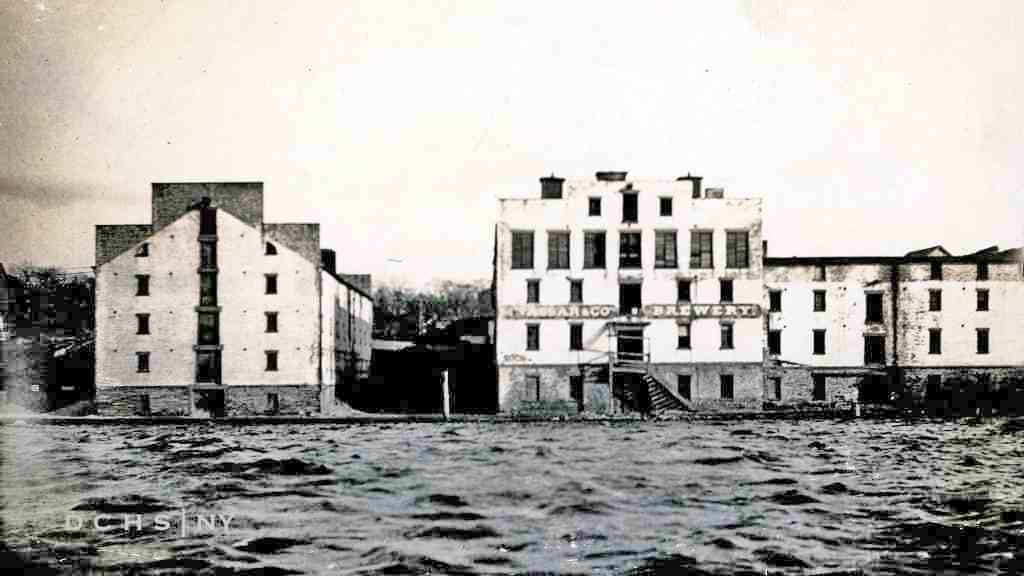
It’s not surprising that America’s first iceboating bar was in Poughkeepsie, New York, acknowledged as the sport’s American birthplace. Though he is often incorrectly cited as being America’s first iceboater, Poughkeepsie resident Oliver Booth and Jacob Buckhout were instrumental in sport’s growth. When Booth, Buckhout, and friends were ready for a cold one, they could have sailed their stern-steers up to the Vassar Brewery on the waterfront, which served as the think tank for early American ice sailing. The brewery also served as the start and finish line for Hudson River regattas.
“The Vassar Brewery office was the club house where all the river sportsmen gathered to discuss matters and partake of Mr. Booth’s specially brewed ale. About 1858 the possibilities of the development of the skate-boats was under consideration among the brewery coterie, and experiments of various kinds were tried with steel runners, heavy and light centre timbers and various cuts of sails.”
THE EAGLE’S HISTORY OF POUGHKEEPSIE BY EDMUND PLATT PUBLISHED IN 1905
I’ve stumbled across many odd connections in the sport’s history, and Vassar University is one of them. The name Vassar is familiar because it is associated with the college founded by the brewer, Matthew Vassar. The brewery building no longer exists, but if you are ever in Poughkeepsie, stop by the waterfront park and hoist a cold one to those who started it all.
I am indebted to Archie Call and Henry Bossett for sharing their early iceboating history research with me.
Like this:
Like Loading...





 America’s First Iceboating Bar & Club House