A brief glimpse of a mention of an iceboat movie, shared by a University of Wisconsin–affiliated Facebook account, sent me down the rabbit hole again. The link vanished almost immediately, but the fragment was enough to send me looking.
The Varsity Movie
The program belonged to a University of Wisconsin student silent film titled The Varsity Movie: “Not Responsible.” It was produced by the Edward Booth Dramatic Club and screened publicly in Madison theaters. It was shot on location around Madison, involved dozens of students and faculty, and was promoted at the time as something new. Link to program.
An Iceboat at the Center of the Story
What caught my attention was the plot.
YELLOW KID
According to multiple 1921 newspaper articles and the program text itself, a central element of the story is an iceboat race. When the male lead is unable to compete, the female lead takes his place, sails the race, and wins.
They did not have to search far for iceboats. William Bernard’s Lake Mendota iceboat rentals were a short walk from campus. The program indicates that filming used two Bernard stern steerers, PROM QUEEN and the better-known YELLOW KID.
Looking through the iceboat.org archives, YELLOW KID appears repeatedly, including in accounts of a race against an automobile. I have not been able to find an independent record of PROM QUEEN. It may have been renamed for the film, or it may have been a lesser-documented Bernard yacht.
What Survives and What Does Not
At that point, the question stopped being whether this was a serious production and became something else. Where does this sit in the history of iceboats on film?
Only paper appears to survive from the UW film. The program, cast lists, production credits, reviews, and newspaper coverage all exist. So far, no film elements have surfaced. I have contacted the Wisconsin Center for Film and Theater Research to determine whether anything survives off catalog.
Even if the film itself is lost, the documentation is clear enough to establish that iceboat racing was used as a narrative device in a motion picture by 1921.
Looking for the Earliest Iceboat on Film
That discovery led to a larger question. What is the earliest filmed iceboating we can actually identify?
Rather than start from scratch, I reached out to iceboat historian and sailmaker Henry Bossett. He pointed me to an Edison actuality titled Ice-Boat Racing at Redbank, N.J., filmed in 1904.
This makes historical sense. By 1904, the Edison Manufacturing Company was actively producing short actuality films, with operations based in West Orange, New Jersey. Red Bank was nearby, and the region was a well-established center of ice yachting.
That Edison film now appears to be the earliest documented motion picture depiction of ice yachting that we can identify with confidence, at least in North America. Link to video.
Narrative Versus Actuality
Seen in that context, the UW film occupies a different and still important place because it may represent the earliest known narrative use of iceboat racing in a motion picture.
Henry also reminded me of a later silent feature, Fascinating Youth from 1926, which is sometimes mentioned in discussions of early youth or collegiate films. Fascinating Youth is a full Hollywood studio production, filled with established stars and directed by Sam Wood. There is no personnel or production connection to the UW film.
Thematically, it belongs to a popular 1920s genre of college stories, not to the experimental, institutionally supported student filmmaking seen at UW in 1921.
Why the UW Film Still Matters
The UW film appears to have been exactly what it looks like. A serious student production, endorsed by faculty, ambitious in scope, and willing to put people and equipment out on winter ice to get the shots.
One participant was Carl Russell Fish, a nationally known historian and senior faculty member. His involvement underscores that this was not treated as a joke or a stunt.
So Far, the Picture Looks Like This
In 1904, iceboat racing is filmed as actuality by Edison. By 1921, iceboat racing is embedded in a narrative student film in Madison. By the mid 1930s, Wisconsin ice regattas are being filmed for international newsreels with clear terminology and context.
The UW film tells us that iceboating was visually compelling, culturally familiar, and narratively useful far earlier than most people assume.
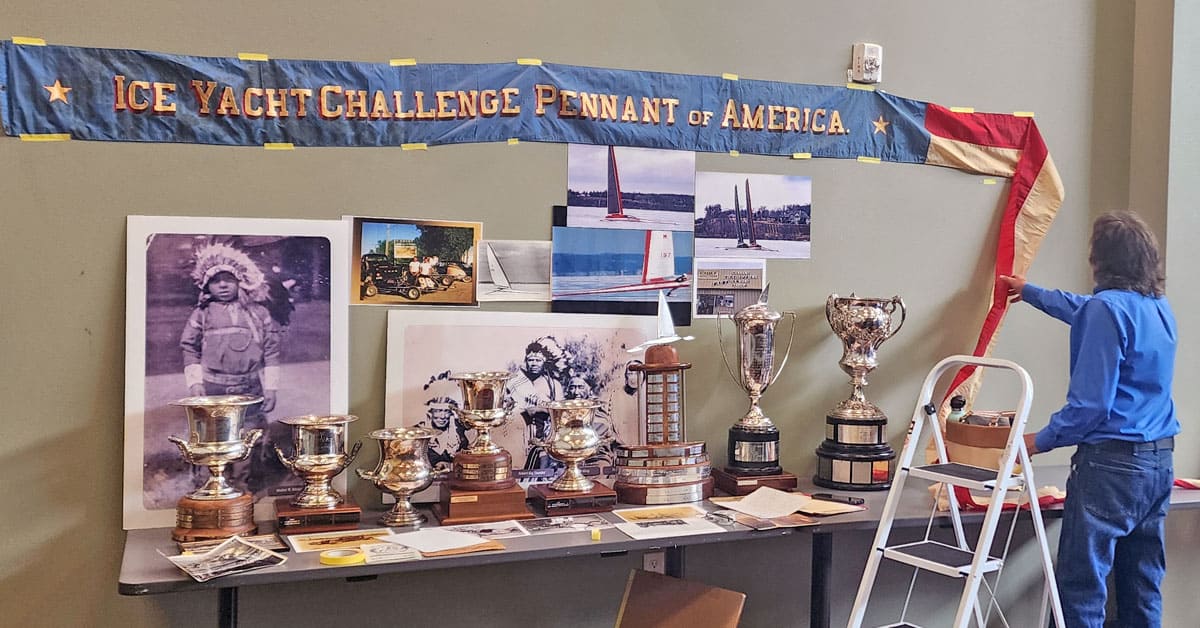
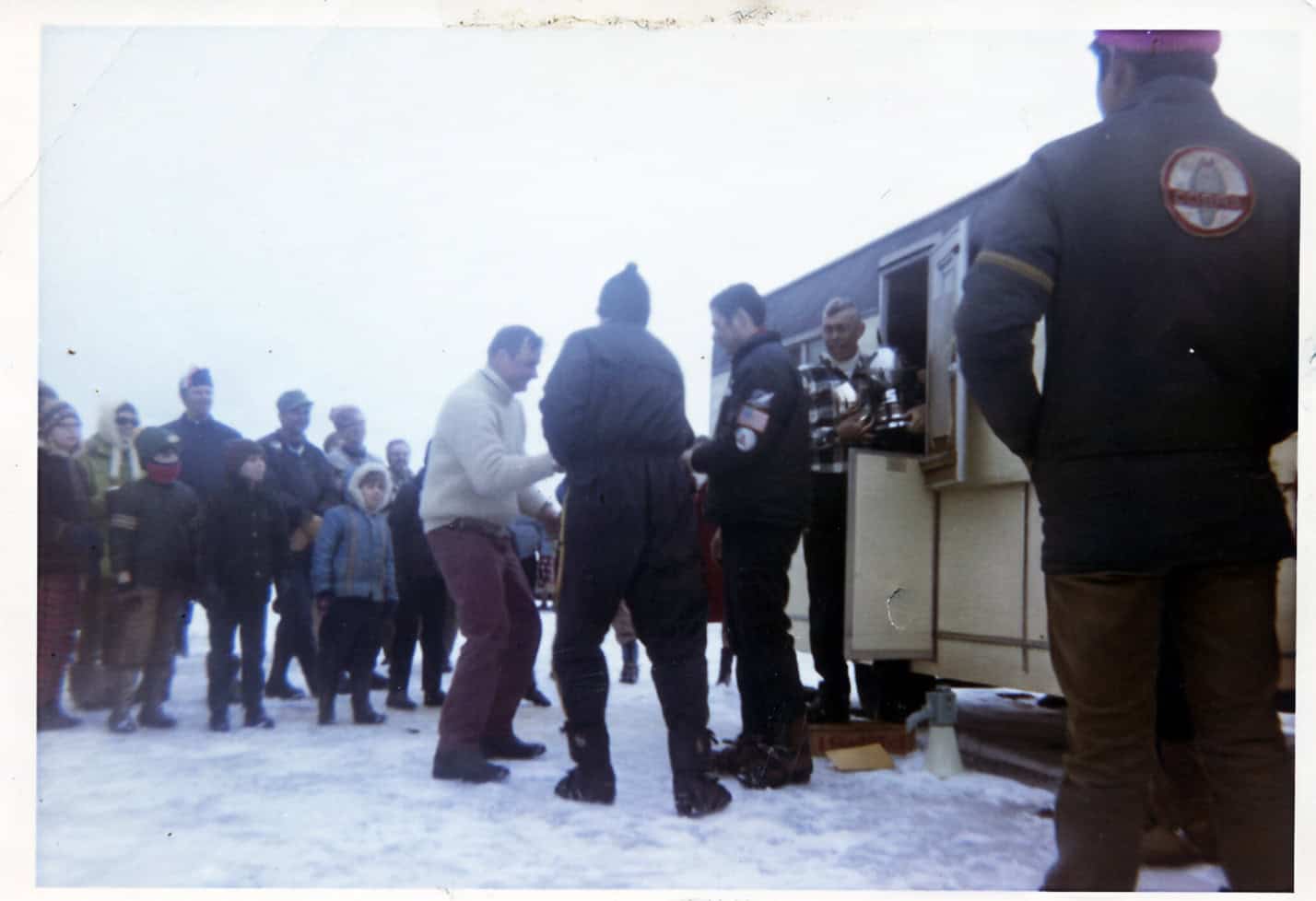
Ken Whitehorse adds the finishing touches to a display honoring the Whitehorse family’s legacy in iceboat and auto racing, featuring historic trophies and family photos.
Skeeter sailor Ken Whitehorse recently participated in an early-stage gathering hosted by Wisconsin Public Television for their upcoming documentary, Wisconsin Hometown Stories: Madison. The two-hour program will explore Madison’s history, focusing on Teejop — the Ho-Chunk name for this region, meaning “Four Lakes.”
WPT is working closely with members of the Ho-Chunk Nation to ensure their stories and perspectives are central to the project. WPT invited Ho-Chunk community members to share their memories of Madison during the event. Ken curated a presentation on the Whitehorse family’s deep involvement in iceboat and auto racing. He displayed several historic trophies — including the Ice Yacht Challenge Pennant, won by AJ Whitehorse in the 1980s — and noted, “Whitehorse names are all over these trophies.” It was a reminder of the family’s long-standing presence in Madison’s sporting culture. We were also blessed by the presence of Ken’s father, Walter Whitehorse — a longtime 4LIYC Skeeter sailor — who recently celebrated his 100th birthday.
A few days earlier, I also spoke with the producer about Madison’s iceboating history and shared memories of my late husband, Harry Whitehorse, whose legacy as an artist and iceboater continues to shape how we remember this place.
FRITZ ARCHIVES
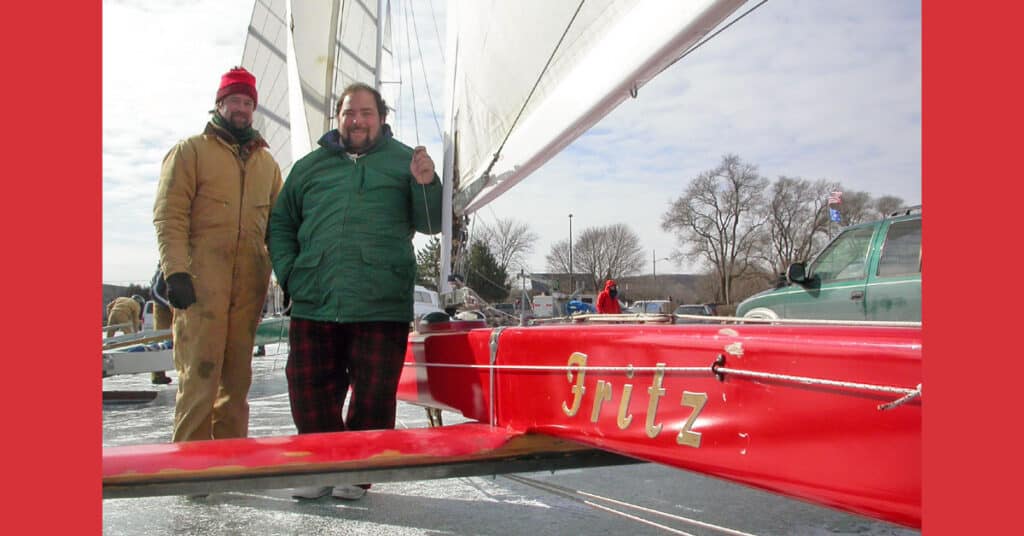
After 25 years of stewardship, Fred Stritt has passed the helm of the historic Class A stern-steerer FRITZ to a new caretaker. The iconic iceboat, built by Carl Bernard, has found a new home on Lake Minnetonka in Minnesota.
Fred shared his thoughts on the transition on the Midwest Hardwater Sailing Facebook page:
FRITZ is an incredible machine—smooth in light air, exhilarating in medium air, and on the edge of terrifying in heavy air. She’s like hanging onto the tail of a dinosaur—if they want you gone, you’ll be flicked off and flying! Congratulations to Bill and his group and I look forward to seeing Fritz blossom under your guardianship!
Some History:
The Class A stern-steerer FRITZ, built by Carl Bernard, roared into iceboating legend as a Madison, Wisconsin icon. Owned by Frederick Jungbluth and sailed by Bernard, FRITZ achieved an extraordinary feat in 1934, winning all four major trophies—the Stuart Cup, Hearst International Trophy, Northwest Class A, and Northwest free-for-all—in a single year, a record unmatched at the time. FRITZ was a powerhouse, and her victories were celebrated in the Wisconsin State Journal and beyond.
Tragedy struck in 1935 when a mysterious fire—suspected to be arson—destroyed FRITZ and her companion, Miss Alice in Madison. Yet FRITZ endured, and Carl rebuilt her after the fire; she was painted bright red to honor her survival. By 1948, with Bill Mattison crewing for 18-year-old Jim Lunder, she reclaimed the Northwest Class A title on Geneva Lake. Please see the FRITZ archives for more history on this boat.
MARY B and FRITZ at the Edgewater on Lake Mendota,
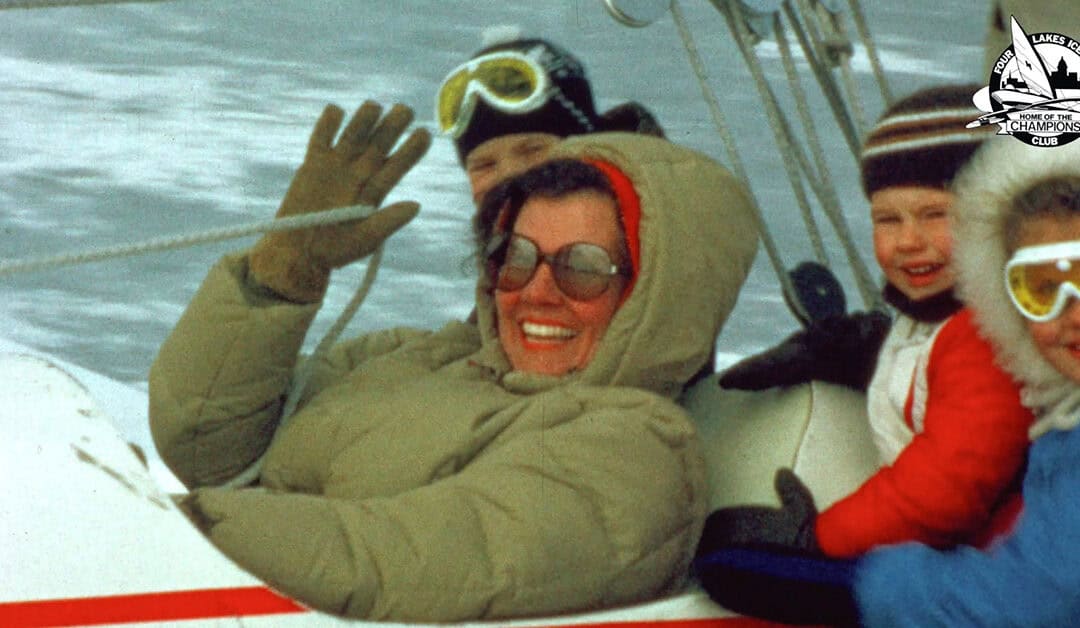
The recent passing of Gloria Melges reminded Don Sanford of a film clip from Bill Mattison’s collection taken at the 1970 International Skeeter Association Regatta, which was sailed on Lake Mendota from February 27 to March 1. Don shared this clip which shows a happy day on the ice for the Melges family and other assorted characters. It also brought back memories because I was there to watch my dad, Dave Rosten, and Buddy Melges tie for first place in that event. Link to Video
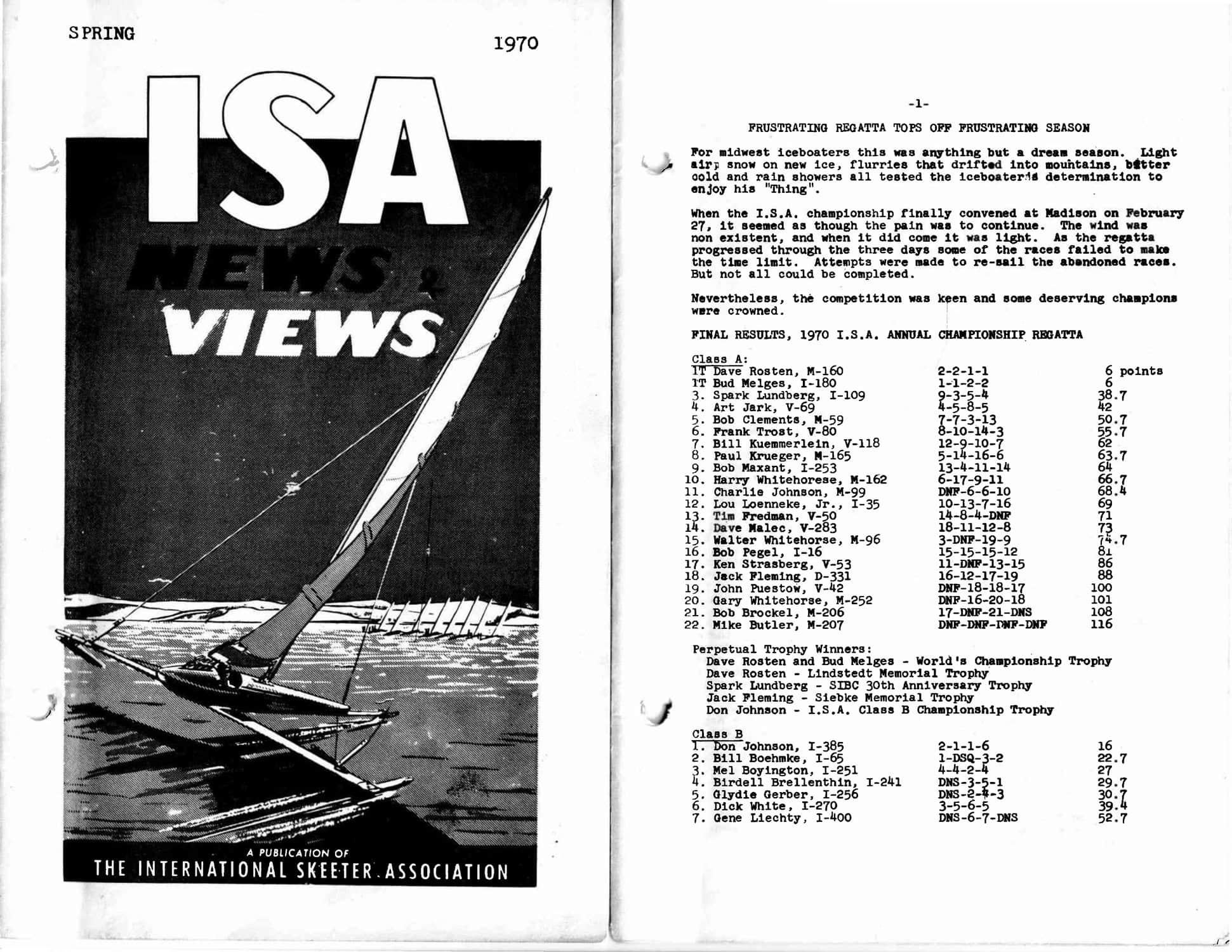
FRUSTRATING REGATTA CAPS OFF FRUSTRATING SEASON
For Midwest iceboaters, this was anything but a dream season. Light air, snow on new ice, flurries that drifted into mountains, bitter cold and rain showers all tested the iceboater’s determination to enjoy his “Thing.”
When the I.S.A. Championship was finally convened at Madison on February 27, it seemed as though the pain was to continue. The wind was non-existent and when it did come, it was light. As the regatta progressed throughout the three days, some of the races failed to make the time limit. Attempts were made to re-sail the abandoned races. But not all could be completed. Nevertheless, the competition was keen and some deserving champions were crowned.
Ever since Buddy Melges’ induction in the first class of 2011, ice boaters have numbered among the elite sailors honored by the National Sailing Hall of Fame (NSHOF). Other hard water inductees include Peter Barrett, Olaf & Peter Harken, Jan & Meade Gougeon, Bill Bensten, Herbert Lawrence Stone (who authored books and articles), Bill Mattison, and Jane Pegel.
The sailing community’s full recognition of the sport of ice yachting has culminated with the inclusion of an iceboat in the new NSHOF museum in Newport, Rhode Island.
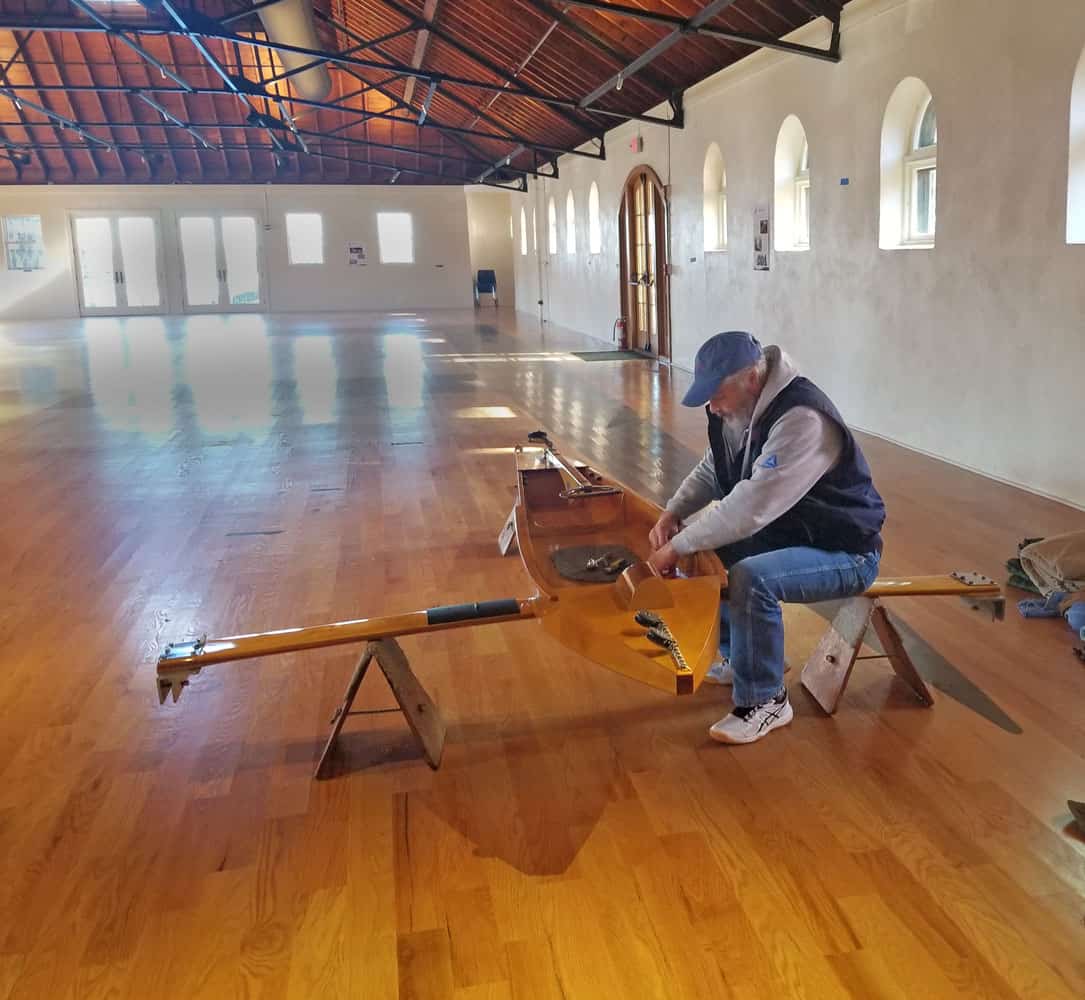
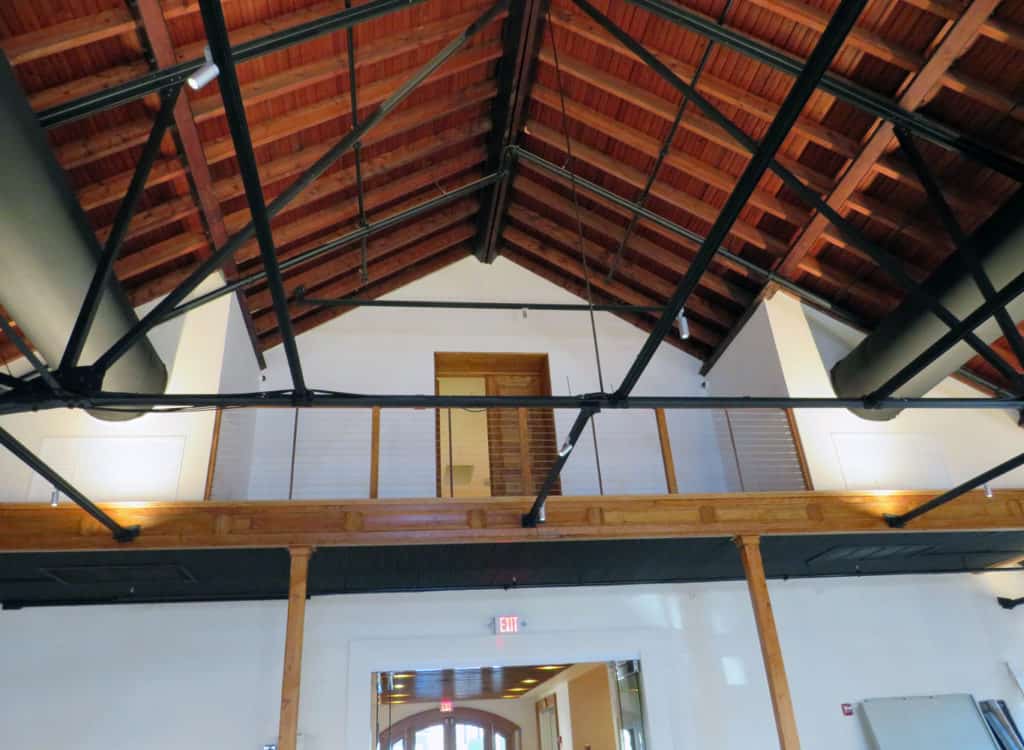
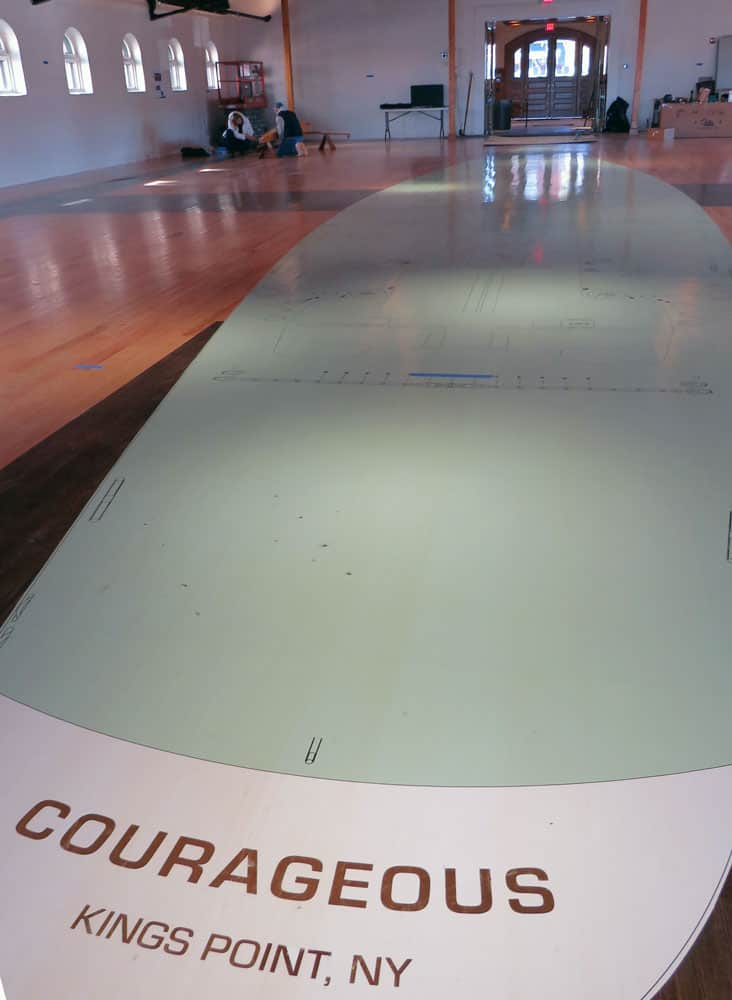
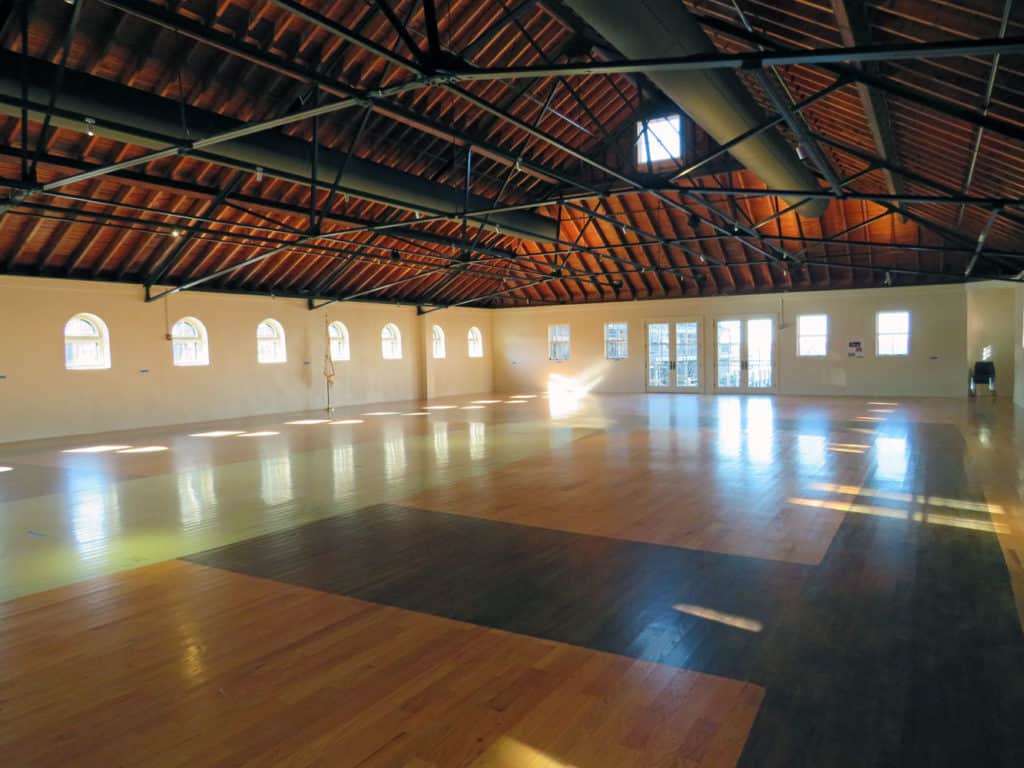
When visitors enter the impressive interactive exhibition hall, they will notice six boats hanging overhead from the exposed wooden rafters of the historic former armory. One of those six is an iceboat representing our community and those who live to “Think Ice.”
The NSHOF asked Four Lakes Ice Yacht Club Nite sailor Don Sanford (the driving force behind Bill Mattison’s induction), myself, and others for an iceboat. The museum had hoped to hang a Class A Skeeter, but the wide plank would have taken up too much space. They chose one that would fit – the most popular iceboat globally, a DN.
Peter Harken asked that the boat not be a “fixer-upper” but a fully fitted racing boat. The NSHOF accepted Four Lakes Ice Yacht Club member Doug Kolner’s offer to donate his complete modern DN.
The DNs natural wood hull and plank, built in a small garage in Monona, Wisconsin, are true to the roots of the DN’s humble beginnings at the Detroit News hobby shop in the 1930s. Doug built the boat using standard DN plans, and it symbolizes all the iceboat builders who enjoy kicking up some dust and mixing epoxy in their garage shops.
Current members of the NSHOF’s influence is evident in the fact that the boat was built using Gougeon brothers epoxy and Harken brothers fittings technology. Doug recognized NSHOF member Bill Mattison and Green Lake Ice Yacht Club’s Joe Norton as the builders who had influenced his iceboat building know-how.



 At that point, the question stopped being whether this was a serious production and became something else. Where does this sit in the history of iceboats on film?