The start of the Chicago Yacht Club Race to Mackinac feels like the halfway point of the off-season until ice sailing season begins. Here’s the annual look through the fleet to see which iceboaters are making the trip north.
This year, though, there’s one familiar name missing. Rick Hennig was a longtime Mackinac sailor, and his absence will be felt both on Lake Michigan and in the iceboating community. As the fleet sets out today, many of us will be thinking of Rick.
Iceboaters racing to Mackinac this year include:
USUAL SUSPECTS
DN champion Ron Sherry
CALLISTO
Co-skipper Steve Orelebeke and crew member Jay Yaeso, both longtime Skeeter sailors
LEGACY
DN sailors Ben Witman and Dave Elsmo, along with Mendota Yacht Club sailor Matt Baron
KASHMIR
DN sailor hailing from the Toledo Ice Yacht Club Jody Kjoller
Best of luck to everyone headed north. Have a safe race, and we’ll be following along from shore.
Ice Riders on the Chesapeake Bay by Charles Wysocki
Here’s our collection of July 4th ice sailing photos, another opportunity to remember that two of the founders, Ben Franklin and John Adams thought about iceboating. Ben even ordered a set of plans! But one ride in the Netherlands was quite enough for John Adams. He wrote to a friend, that iceboating “as again endangered my Health and my Life.” Enjoy the holiday and Think Ice! When Ben Franklin Ordered Iceboat Plans Ben Franklin’s Iceboat Drawings
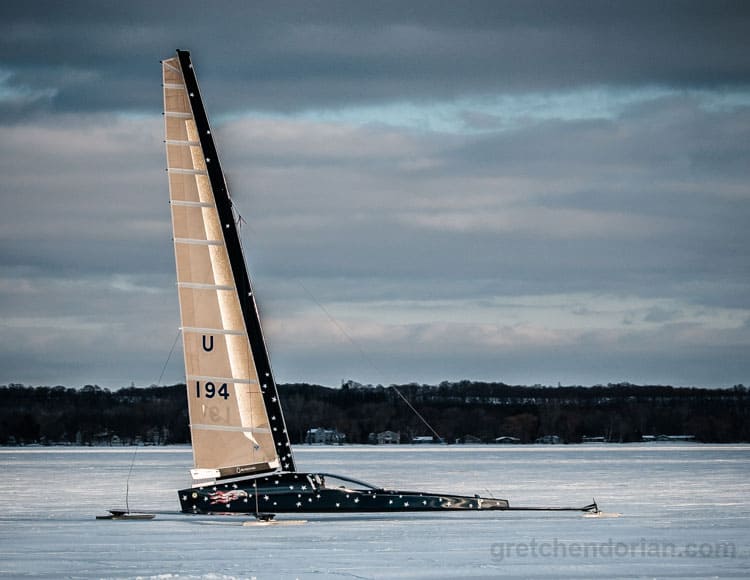
JD’s EAGLE, Class A Skeeter. Photo: Gretchen Dorian
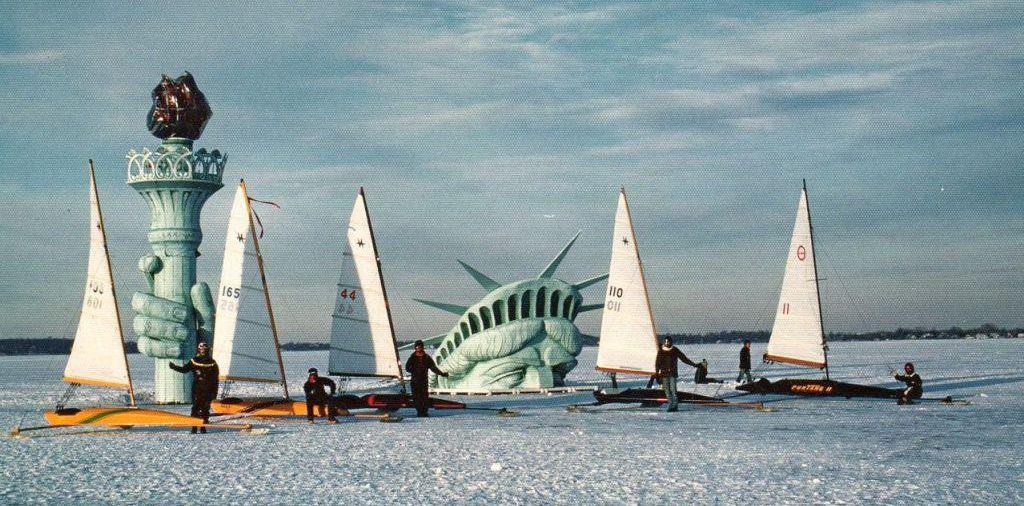
Shown here from left to right doing their best to make the ordinary extraordinary are: Don Ermer, Don Sanford, Steve Arnold, Lady Liberty, Ty Reed and Ken Kreider.
Paul Krueger’s legendary Skeeter RAMBL’N has a new owner, but one thing isn’t changing. The boat will continue to sail under the name RAMBL’N.
Lake Geneva’s Kyle Navin has purchased the boat. Kyle has an impressive sailing résumé, representing American Magic in the Youth America’s Cup, winning the 2025 E Scow National Championship, and finishing second at the 2026 Nite Nationals. He also represents another accomplished sailor making the jump into Skeeters. Last season, multi-time DN World Champion Matt Struble purchased Tom Hyslop’s Skeeter. Those additions can only make an already competitive fleet even stronger.
RAMBL’N won’t be sitting in the trailer very often. When Kyle is away competing in one of his many sailing campaigns, his father, Dave Navin, will take the helm. Dave comes into the Skeeter fleet fresh off his victory at the 2026 Nite National Championship, with Kyle finishing second.
Paul Krueger campaigned his many RAMBL’N Skeeters since the late 1950s, making it one of the best-known Skeeters in the fleet. It’s good for iceboating to see the boat staying in the hands of a family that will continue to race it hard while preserving its identity.
UPDATE: Funeral Information Date: Friday, June 26 Visitation: 9 AM – 11 AM Service: 11 AM Location: Delavan United Methodist Church 213 S. 2nd Street, Delavan, WI. LINK TO MAP
Memorials in Janes name may be directed to Geneva Lake Sailing School LINK or Green Lake Area Animal Shelter.
Arrangements made by Toynton Funeral Home, 328 Kenosha Street, Walworth, WI (262) 275-2171. Susie requests that if you attend the funeral, please wear your sailing apparel. Jane Pegel Archives
Via Susie Pegel
Jane Pegel died this morning, June 6, 2026, at the age of 92. Jane began her iceboating career sailing a Skeeter I-169 named “Holy Smoke.” Around 1956 she made the transition to DNs, first racing with number 305 and later 805. She was DN class champion in 1961 and 1963 and served as DN technical committee chairperson for decades. She was in the group that founded the National Iceboat Authority that formulated right-of-way rules for iceboats. Jane met her husband Bob Pegel while iceboating. Jane is survived by daughter Susie Pegel (formerly DN 905) and grand-cat Sweet Pea who was adopted from the animal shelter in Green Lake in 2020.
Many of today’s sailors may not realize how much of the sport they enjoy was shaped by Jane’s work and dedication. She was a competitor, an organizer, a rule maker, and a trailblazer whose influence extended far beyond her own racing career.
Our thoughts are with her daughter, Susie Pegel, family, and friends. Susie reports that a funeral service is being arranged, likely for later in June.
RESULTS
The photos tell the story. This looks like one of those events people will regret missing, with a lot of “you had to be there” stories coming out of Jungo Yacht Club.
After three days of racing in a variety of wind conditions, 5-time DN World Champion and 14-time DN North American Champion Ron Sherry claimed victory in the A Fleet with 12 points. Daniel Hearn, who invited Ron and Leon Lebeau to Nevada and supplied the boats they sailed, finished second with 16 points. Not bad for Ron’s first attempt at land sailing and his transition from ice to dirt was clearly successful.
When Daniel called and suggested the trip, Ron didn’t need much convincing. “Leon and I have been wanting to try that forever,” Ron recalled.
Daniel arrived with a trailer full of land yachts. Scott Dale provided the venue, having purchased the property and developed Jungo Yacht Club into one of the premier land sailing destinations in North America. During the day, sailors raced. At night, everyone gathered around campfires, shared meals, and traded stories.
Forty-six boats competed, divided evenly between A and B Fleets, with 23 boats in each fleet. In B Fleet, Reed Lorimer took top honors. The Mini-Max team competition, which paired one A Fleet sailor with one B Fleet sailor, added another dimension to the regatta. Augie Dale and Reed Lorimer captured the team title, while Ron Sherry and Leon Lebeau finished second.
One of the highlights came Saturday evening during a night sail under the full moon. Sailors raced a relay course using giant glow sticks as marks, creating the kind of scene that sounds almost too good to be true until you see the photographs.
Congratulations to Scott Dale and the Jungo Yacht Club crew for creating what appears to have been an unforgettable event.
Something tells me a few ice sailors just added Jungo Yacht Club to their bucket list. For Daniel Hearn and several others, the adventure began months ago in Damien Luyet’s shop, where the gang has been logging long hours building a fleet of Mini Skeeters in preparation for this event. Kudos to Daniel Hearn for putting people in boats, no matter what the surface!
Daniel Hearn, North America’s top recruiter in ice and land sailng.
Sherry Opens with Three Bullets at the Mini-Max Regatta Results
Yesterday, Friday, May 29, was the first day of racing at Jungo Yacht Club near Winnemucca, Nevada.
After rain flooded the playa earlier in the week, conditions improved quickly as expected. The water disappeared, the surface dried, and sailors were able to get in some training on Thursday afternoon before racing began on Friday.
Last night, Leon Lebeau called in with a report from the playa.
The wind was blowing around 30 mph, and you can hear it in the videos. Speeds were impressive. Leon reported that Daniel Hearn recorded a run of 60 knots. (i’ll post a short video in the 4LIYC Facebook group.)
Leon and Ron Sherry were both highly complimentary of Jungo Yacht Club, the land sailing facility created by Scott Dale. Iceboaters will recognize the family name. Scott’s father is Bill Dale of Pewaukee, Wisconsin, a longtime Skeeter sailor.
The fleet self-selected into A and B divisions. In addition to the individual competition, sailors are also competing in a team event. Each team consists of one A Fleet sailor paired with one B Fleet sailor, with their combined scores determining the team standings. Leon is competing in B Fleet while Ron is sailing in A Fleet. Leon said the format adds another layer of fun to the regatta and keeps sailors engaged throughout the fleet. (Ron and Leon are hot-bunking a Mini-Skeeter, provided by Daniel Hearn.)
While Leon was on the phone, Ron stepped into the motorhome, giving me a chance to ask how land sailing compares to iceboating.
“The vibration,” Ron said. The constant vibration as the tires roll over the playa surface was one of the biggest differences to get used to.
Whatever the adjustment, it didn’t seem to slow him down. Ron opened the regatta with three bullets in the A fleet and leads the standings after the first day. Daniel Hearn stands in second place. Reed Lorimer is in first in the B fleet.
One thing noticeable in the photos is that everyone is wrapped up in jackets. Winnemucca sits in Nevada’s high desert, and temperatures can be surprisingly cool, especially once the sun begins to drop behind the mountains.
Leon also spoke highly of the sense of community that land sailing creates. Unlike many racing venues, everyone is essentially living together out on the playa. Campfires, shared meals, stories, and bench racing become a big part of the experience.
Last night, the sailors gathered for a group dinner before preparing for another day on the desert.
Sitting around the imaginary campfire
Leon said the course took a little getting used to compared to an ice sailing course but was easy to figure out.