by Deb Whitehorse | Jun 6, 2026 | 2025-2026, Bob & Jane Pegel Slides, Home Page

UPDATE: Funeral Information
Date: Friday, June 26
Visitation: 9 AM – 11 AM
Service: 11 AM
Location: Delavan United Methodist Church 213 S. 2nd Street, Delavan, WI. LINK TO MAP
Memorials in Janes name may be directed to Geneva Lake Sailing School LINK or Green Lake Area Animal Shelter.
Arrangements made by Toynton Funeral Home, 328 Kenosha Street, Walworth, WI (262) 275-2171.
Susie requests that if you attend the funeral, please wear your sailing apparel.
Jane Pegel Archives
Via Susie Pegel
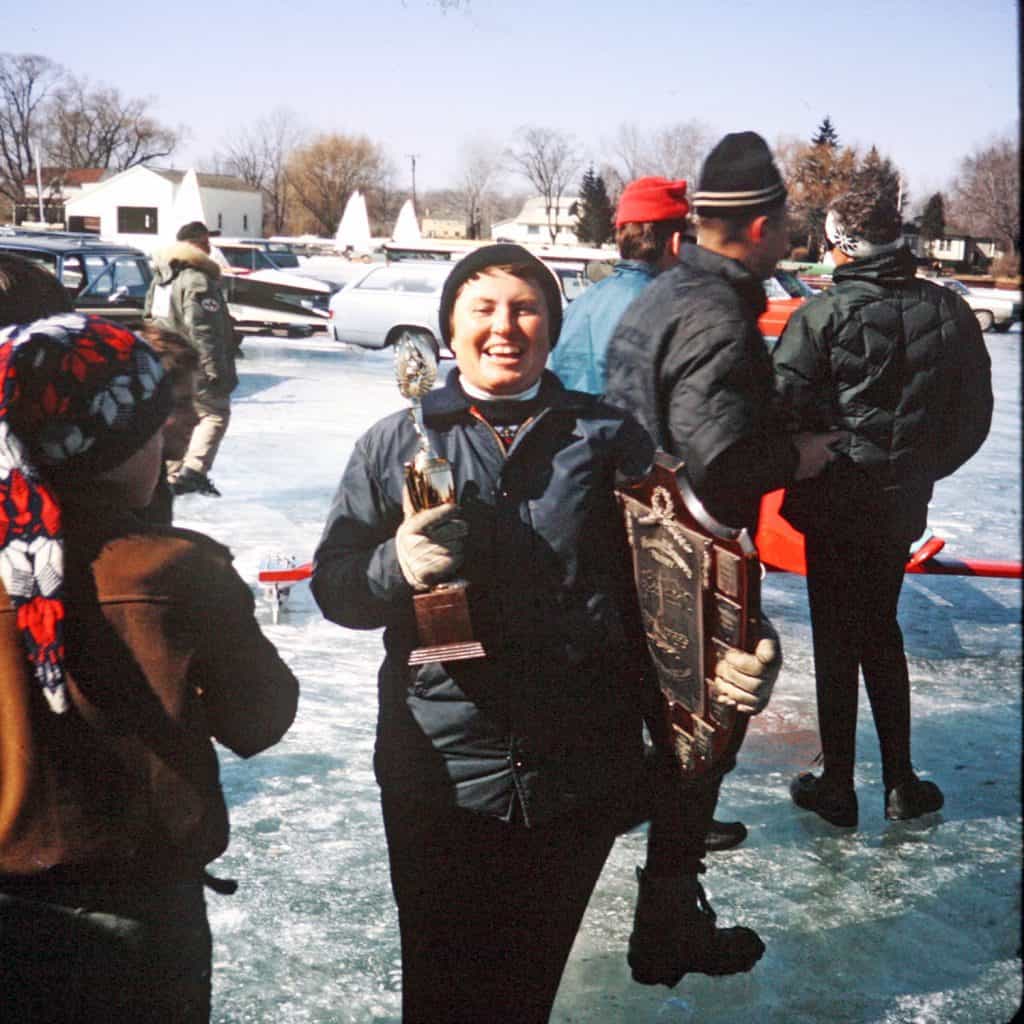
Jane Pegel died this morning, June 6, 2026, at the age of 92. Jane began her iceboating career sailing a Skeeter I-169 named “Holy Smoke.” Around 1956 she made the transition to DNs, first racing with number 305 and later 805. She was DN class champion in 1961 and 1963 and served as DN technical committee chairperson for decades. She was in the group that founded the National Iceboat Authority that formulated right-of-way rules for iceboats. Jane met her husband Bob Pegel while iceboating. Jane is survived by daughter Susie Pegel (formerly DN 905) and grand-cat Sweet Pea who was adopted from the animal shelter in Green Lake in 2020.
Many of today’s sailors may not realize how much of the sport they enjoy was shaped by Jane’s work and dedication. She was a competitor, an organizer, a rule maker, and a trailblazer whose influence extended far beyond her own racing career.
Our thoughts are with her daughter, Susie Pegel, family, and friends. Susie reports that a funeral service is being arranged, likely for later in June.
Fair winds, Jane.
Like this:
Like Loading...
by Deb Whitehorse | May 18, 2026 | 2025-2026, Home Page, NIYA, WSSA
54′ of Fast: Link to Video

Rick Hennig’s nephew, Dave Elsmo, shares his thoughts about Rick below. Rick’s investment in Dave paid dividends. Dave has gone on to give countless of University of Wisconsin students their first iceboat rides and has brought many new sailors into the DN fleet.
Dave is also the videographer behind the video above, 54′ of Fast. When people ask me about iceboating, this is one of the first videos I show them. I’ve shared it countless times over the years.
Following Dave’s words, fellow stern-steerer sailor Dave Lallier, who understands what it takes to care for one of these historic boats, shares his thoughts about his friend Rick.
The Roots Rick Planted
Dave Elsmo
As the Greek proverb goes, “A society grows great when old men plant trees whose shade they know they shall never sit in.” In my moments of reflection over the past few days since Rick’s passing, this thought has kept coming back to me. I think it describes the man very well in all of his pursuits.
Whether it was the soft-water programs, his cars, his iceboating, or his local community, Rick was always doing something that would inevitably benefit people he may never meet or live long enough to see impacted by his generosity. It didn’t matter. I’m not even sure that thought ever crossed his mind. He never seemed particularly interested in gaudy announcements proclaiming his involvement. If something needed doing or somebody needed help, he stepped in with his time and resources. The best of those resources was always the people he surrounded himself with. The Cabbage Patch crew was never far behind.
I remember coming back from college broke and lacking much motivation. Rick put me to work fairing the hull, plank, and mast of the DEUCE. Anybody looking at the boat would have said it was already perfect, but for days on end he kept coming back to me and another kid working with me, telling us to keep going. We were there until the boat was perfect — his version of perfect.
At the time, I knew nothing about iceboating, and I had no idea how profound the piece of equipment I was working on really was. I just knew the work was mind-numbing. While I piddled away with putty and sandpaper, Rick and a group of friends were building a wheelchair ramp for a friend’s family member. I didn’t fully digest it then, but he was doing it simply because it was the right thing to do and because someone he cared about had a need. It really was that simple and my job was to do the mind numbing stuff so he could do more important stuff.
I didn’t have much of a relationship with Rick in my younger years. I sailed casually around the local club and saw him here and there at family events. Then, out of the blue during the winter of my sophomore year at Minnesota, Rick called and told me he had picked up an iceboat from a friend and wanted me to have it and start racing. I knew absolutely nothing about the sport, but winters in Minneapolis were boring, so I picked it up one random weekend and waited for ice. A local friend from scow racing, Jim McDonagh, was an avid DN racer who told me about an event outside the Cities and said to just show up. I had no idea what I was doing. I had the boat, one wrench, and some fuel in the tank. I hit the ice, caught a puff, ripped off into a snow squall following Jim to the course, and never looked back.
The next summer, Rick told me to show up at a swap meet in Lake Geneva, so I made the trip. He had picked up a trailer from the Pegels, a mast and set of runners from Ron Sherry, and a new sail. His thinking was that with the trailer I could get more people onto the ice and that’s exactly what happened.
I scratched around for loaner boats and soon had four programs going to get others involved in the sport. Having travel partners made it financially possible for me to keep traveling, but more importantly, it helped grow the fleet.
As I fell deeper into the sport, Rick already had another plan. There was still a massive pile of Sitka spruce sitting in his shop from the DEUCE build, so he and the Cabbage Patch crew pumped out eight or ten sets of DN sideboards and started building. They got one hull started, which I picked up along with the rest of the sideboards, and I haven’t stopped building since.
I still laugh at the idea that the scraps from the DEUCE build were enough to create an entire flotilla of DNs. Today, every set of those boards is still in the fleet and racing. Young sailors who started in those loaner boats eventually built their first hulls from some of the best wood imaginable, all sharing the same genealogy as the DEUCE.
Many of the people who started iceboating and building with that wood eventually found their way onto Rick’s summer programs. Most of them are still racing together today because he took a chance on younger people. He brought the opportunities; we brought the bodies to sail boats that always seemed to get bigger and more terrifying to manage.
That brings me back to the DEUCE.
That boat is one hell of a program. When it leaves the shed, an army of people moves across the country to make sure there are enough hands to rig, enough bodies to rotate in for racing, and enough old-timers in the pits to keep everything safe, or at least as safe as it could be. Rick took care of all of them. He spent more time making sure everybody had what they needed than sailing. I had only taken a ride on the boat twice before Rick told me to take the tiller. I’m lucky I was wearing brown coveralls that day. Despite my concerns, a few of us from the Cabbage Patch crew went out for a spin. To this day, my hands still get sweaty thinking about that ride.
The men who (re)built these A-Class stern steerers were a different breed. They are unlike anything I see coming down the pipeline anytime soon. They are unreasonable, unruly, unpredictable, unnecessary, unwavering and at this point, I’m not sure whether I’m talking about the man or the boats now
Great men are compelled to do great things, especially when they are determined to preserve history while fostering new generations. Rebuilding the boat was a community event and sailing the boat is a community event. The boat was only the mechanism, community was the point all along.
This story is just one of hundreds that will emerge over the coming weeks as people find moments to reflect on a life well lived. Mine is only a small piece of a much larger story others may never know. I would challenge others to take a moment to write or reflect on their own experiences with Rick.
The thing about planting trees whose shade you’ll never sit in is that you never know where those roots reached. Rick likely never realized how many people he set in motion, how many friendships, programs, boats, and traditions grew from the opportunities he created. But that’s the mark of a great man. He planted anyway.
By Dave Elsmo
We Are All Just Caretakers
By Dave Lallier
I first met Rick when he brought the DEUCE to Lake Winnebago near my house. It must have been shortly after he acquired her, as he was still using cotton sails. I was fortunate to have had some great sails on her with Rick.
At about the same time, my brother Jeff and I were in the middle of restoring the FLYING DUTCHMEN. Rick took great interest in the restoration, as he was doing the same with the DEUCE. We had many discussions regarding the work being done. Rick was aware that we would need a new runner plank and offered to help.
After the new backbone for the DEUCE was completed, he suggested that a new plank be built at his shop. My brother Jeff was working in Milwaukee at the time, so he traveled to Rick’s every evening to work on it. Rick had all the designs and methods in place, as well as the tools and wood for the job. As you can see today, the plank is a true work of art.
After the plank was done, I asked Rick where we should go to have new stays for the mast made. He told me to assemble the boat in our yard and that he would come help. He showed up with a large hydraulic swaging machine and a bunch of cable. That afternoon, the DUTCHMEN’s mast stood again with all new stays and adjuster tubes that Rick made.
I asked him where he got all that stainless cable. He smirked and said, “Watch the evening news because there may be some sailboat masts falling over in Racine.” We had a good chuckle.
If it hadn’t been for Rick, I’m not sure the DUTCHMEN would be sailing today. It takes special people to keep these large historic yachts sailing. It has been said many times that nobody really owns these boats; we are all just caretakers of them.
Rick called me in February 2025. I was sitting in my car on the ice near Fond du Lac, watching the awards being handed out for the Wisconsin Stern Steering Regatta. We had a wonderful talk. He told me he wished he could have brought the DEUCE, but couldn’t because he wasn’t feeling well. He didn’t tell me what was wrong, but I had a bad feeling. That was the last time we talked.
As has been said before, iceboaters are a very close family. Weeks, months, and sometimes years may pass before we see each other, but reunions feel like we were together just yesterday.
The greatest gift Rick gave me was his friendship.
Dave Lallier
Former caretaker, FLYING DUTCHMEN A8
I’d like to add one small story of my own because it says something about Rick’s lasting impact on ice sailing.
On the same day Rick passed away, I called my brother, Ron Rosten, to tell him the news. Ron paused and said, “Wow, that’s strange because I was just thinking about him.” Earlier that very day, a group of Four Lakes Ice Yacht Club sailors had been gathered in Damien Luyet’s shop cutting up some of the original Sitka spruce left over from the DEUCE project.
Even now, wood from Rick’s rebuilding of DEUCE is finding its way into new boats and new sailors’ hands. It felt like one more reminder that Rick’s influence on the sport is still moving forward – Deb
Like this:
Like Loading...
by Deb Whitehorse | Jul 31, 2025 | 2025-2026, NIYA
1925 photo via Kristopher Strebe
An Iceboater at Indy? The Mel Jones Story
Until recently, few in the sailing or iceboating worlds knew that one of our own, Mel Jones, raced in the 1925 Indianapolis 500. As far as we know, he remains the only iceboater and A Scow sailor to have ever taken the starting flag at Indy.
That remarkable fact came to light thanks to Kristopher Strebe, a racing historian from Seattle and native of Janesville, Wisconsin. Kristopher has made it his mission to uncover the full biographical details of every driver who has competed in the Indianapolis 500.
A few days ago, Kristopher contacted me to ask if I had ever seen a photograph of Mel Jones. Fortunately, the Carl Bernard scrapbook provided what we needed, as Carl had pasted a large picture of Mel on one of its pages.
Kristopher also sent two black and white images from the 1925 Indy 500, one of a driver seated in car number 7 and another standing trackside. He had a hunch that the man in the photos might be Mel, the longtime sailmaker and a former Commodore of the Lake Geneva Yacht Club.
When we compared the photographs, it became clear that the man in the 1925 image was Mel Jones. Lake Geneva Yacht Club members Ellen Bentsen and Susie Pegel, both of whom knew Mel personally, immediately recognized him. Additional details from the LGYC yearbook and sailing community archives began to align. Kristopher’s research, combined with local knowledge, confirmed what none of us had known before: Mel Jones took the start of the 1925 Indianapolis 500, driving in relief for car owner Harold John Skelly.
Mel Jones: Sailmaker, Iceboater, and Indy Driver
Melville C Jones was born in Oak Park, Illinois in 1901. A sailor from a young age, he raced A Scows and iceboats out of the Lake Geneva Yacht Club and eventually became a respected sailmaker with Murphy and Nye, Joy Brothers, and later his own loft, Jones Brothers. He was a charter member of the Skeeter Iceboat Club, sailed a Skeeter named GREEN GHOST, and served as Commodore of the Northwest Ice Yachting Association in 1947.
But in 1925, his name briefly surfaced in another arena: automobile racing. That year, a 21-year-old named Harold John Skelly built and entered a car for the Indianapolis 500, powered by a Frontenac Ford engine. Skelly, also from Oak Park, was a student of engineering and had no prior racing experience. He qualified impressively at over 88 miles per hour, but on race day, the track physician ruled him ineligible to compete due to a heart condition.
Mel Jones took his place behind the wheel.
Official records confirm that Jones started the race in car number 7 and completed about 30 laps before the car retired with mechanical trouble. His participation was so under the radar that many accounts at the time overlooked the driver change entirely. Even decades later, his name remained disconnected from the event until Kristopher Strebe’s research brought it to light.
A Shared Skillset: From Iceboats to Indy
The story raised an intriguing question: how did a sailor and sailmaker end up racing at Indianapolis?
For those in the iceboating world, the answer makes perfect sense. Iceboats demand custom fabrication and mechanical intuition. Several iceboat builders including my father, Dave Rosten, Paul Krueger, and my late husband, Harry Whitehorse, have deep roots in motorsports. Metal parts for iceboats are rarely available off the shelf. Everything from the steering assembly to the runner plank hardware must be built by hand.
It is not hard to imagine Mel Jones moving comfortably between those two worlds.
Not to Be Confused with Milton Jones
It is worth noting that Melville C Jones is not the same person as Milton Jones, another early Indy driver who was fatally injured during practice for the 1932 Indianapolis 500. The two men have occasionally been confused in historical references, but they were entirely separate individuals. UPDATE: “Mel and Milton Jones were confused for so long because most documents and reports referred to them simply as M.C. Jones.” Kristopher Strebe. Mel Jones raced only in 1925 and lived a long life devoted to sailing, sailmaking, and the Lake Geneva community.
Who Built the Car?
One mystery remains. According to the 1983 Lake Geneva Yacht Club yearbook, Mel Jones was the “designer and builder of an Indianapolis 500 race car which finished first among the independent builders at the 1925 time trials.” Newspaper accounts from the time, however, credit Skelly as the car’s builder. It is possible both men were involved. Skelly had a technical education, and Mel certainly had the hands-on experience and design background to contribute meaningfully.
For now, the question of who actually built the car remains unanswered. But one thing is certain: Mel Jones drove in the 1925 Indianapolis 500, making him the only known iceboater to have ever done so.
I am indebted to the research of Kristopher Strebe. Tip of the Helmet to Susie Pegel and Ellen Bentsen for their input.

Skelly seated in the car. Mel Jones standing far right. Photo via Kristopher Strebe.

Like this:
Like Loading...
by Deb Whitehorse | Aug 29, 2023 | 2023-2024, Home Page

Ron Sherry inspects the Class A Skeeter LOST KAUS at last year’s swap meet at the Delavan Yacht Club in Delavan, WI.
2023 Annual Wisconsin Swap Meet Hosted by the Green Lake Ice Yacht Club
Date: Sunday, October 22, 2023
Time: 9 AM – Noon
Location: Town Square, Green Lake, WI
Our Green Lake Ice Yacht Club friends are preparing for their turn at the yearly iceboat swap meet. This event was initially established by Bob and Jane Pegel of the Skeeter Iceboat Club and was held in Williams Bay, WI for many years. Nowadays, the swap meet rotates between the Skeeter Iceboat Club, Four Lakes Ice Yacht Club, and Green Lake Ice Yacht Club.
Stay tuned for more details!
Like this:
Like Loading...
by Deb Whitehorse | Nov 14, 2022 | 2022-2023, Home Page

Skeeter Iceboat Club Lifetime Member, Mary Jane Schalk
Via Skeeter Iceboat Club member Susie Pegel:
On November 12, at the annual fall meeting of the Skeeter Ice Boat Club, four individuals were honored for their support of the sport of iceboating: Bestowed Life Membership included Fritz Button who races a self-built B Division Skeeter; B Skeeter skipper Bob Mereness whose father was a Life Member and a founding member of the SIBC; and Lou Loenneke who began iceboating when a youngster and eventually won Skeeter and DN championships. Mary Jane Schalk was granted Honorary Membership. When help is needed, she is the first to step forward to do scoring, service the chow line. or hold the end of the tape measure.
Like this:
Like Loading...