While we wait for Mother Nature’s super Zamboni to finish its work, with rain turning to snow over the next couple of days, there is time to look backward. A dive into the Daily Cardinal archives turned up an unexpected addition to Madison’s iceboating story.
The recent post about the UW student film Not Responsible led me into the University of Wisconsin newspaper The Daily Cardinal archives. While looking for references tied to the film, I started poking around more broadly to see what the paper had written about iceboating.
Iceboating appears in the Daily Cardinal from the late nineteenth century onward, and by the 1920s it was treated as routine winter life on campus. Boats were raced, rented, and rarely explained to readers. The paper assumed its audience already understood what iceboats were and how they fit into life on Lake Mendota.
One of the things I found along the way was a small but important addition to the Charles Lindbergh story in Madison.
For years, Lindbergh’s connection to iceboating here has been told through a story that centers on the motorized ice craft he helped build on Lake Mendota in 1921, powered by a motorcycle engine geared to an airplane propeller. That account is well documented, and it still stands.
What the Daily Cardinal archive adds is one more fact. In a 1929 article reflecting on Lindbergh’s Wisconsin years, the paper notes, without emphasis, that he owned an iceboat while he was a student. Iceboating was part of ordinary winter life on Lake Mendota at the time.
Lindbergh’s motorized iceboat looks like an extension of something he already understood well, speed on ice.
Family context helps explain why. Lindbergh’s maternal grandmother was a Lodge from Detroit, and his cousin Joe Lodge (part of the trio who designed the DN) was an active iceboater there. Detroit, like Madison, was a center of iceboating and mechanical experimentation in the early twentieth century. Iceboats there were not just raced but modified, tuned, and pushed. Lindbergh arrived in Madison already comfortable with machines, ice, and speed.
A later source adds more to Lindbergh’s connection to iceboating. In Evolution of Modern Sailboat Design, Meade Gougeon notes that Lindbergh is said to have assisted his cousin Joe Lodge with the design of a highly advanced rig installed on the Class A stern steerer DEUCE II in the mid 1930s. The boat featured a rotating wing mast believed to be the first of its kind. Although DEUCE II suffered repeated rigging failures, the concept carried forward, and Lodge went on to win the Stuart Cup and Hearst International Trophy in 1938 with the rebuilt DEUCE III. The account suggests that Lindbergh’s interest in iceboating did not end in Madison, but extended into later experimentation at the highest level of the sport.
Daily Cardinal, February 22, 1929
Joe Lodge, holding an iceboat runner, with Fritz Jungbluth in Detroit, 1937. Lodge was a cousin of Charles Lindbergh. Photo from the Bernard scrapbook collection.
Motorized iceboat likely powered by a Ford Model T engine. This is a separate experiment from Lindbergh’s motorized ice craft.
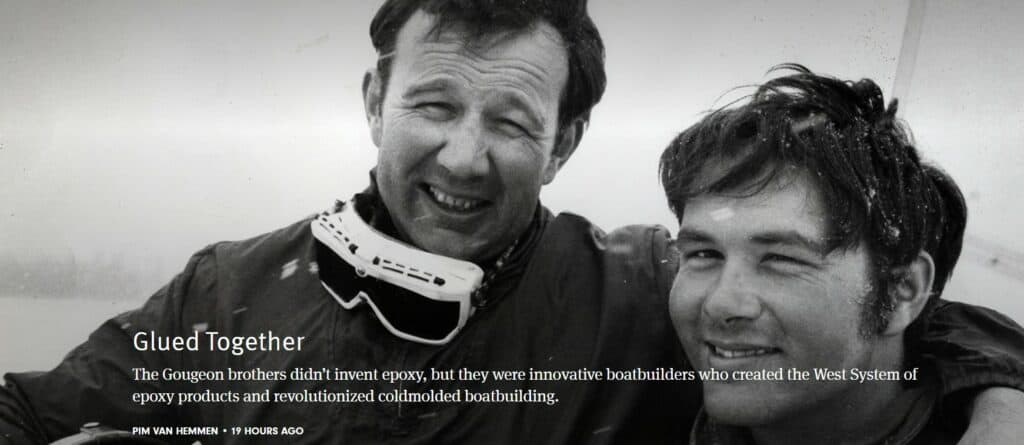
There’s a pattern here. Iceboating has been a source of inspiration for sailing technology innovations. The Harken brothers developed improved blocks for iceboats before expanding into the broader sailing market. Similarly, the Gougeon brothers’ groundbreaking epoxy invention was first put to the test on iceboats, revolutionizing construction techniques and paving the way for advancements in boat building across all sailing disciplines. These instances underscore the significant role that iceboating has played in shaping modern sailing technology and design. One of the best articles ever written about the brothers who invented what holds us together. Read it here.
From Soundings:
Glued Together The Gougeon brothers didn’t invent epoxy, but they were innovative boatbuilders who created the West System of epoxy products and revolutionized coldmolded boatbuilding. PIM VAN HEMMEN
Michigan was a hotbed for iceboating and the Gougeons were DN iceboaters. The DN iceboat had been designed for the Detroit News in the 1930s and had quickly become the most popular iceboat in the world. The little racers were fast, but also light, and the high loads they operated under made them prone to operational failures. Broken masts and cracked runner planks were not uncommon. In Meade’s eyes, the DNs were a great test bed for epoxy. Continue reading.
Ever since Buddy Melges’ induction in the first class of 2011, ice boaters have numbered among the elite sailors honored by the National Sailing Hall of Fame (NSHOF). Other hard water inductees include Peter Barrett, Olaf & Peter Harken, Jan & Meade Gougeon, Bill Bensten, Herbert Lawrence Stone (who authored books and articles), Bill Mattison, and Jane Pegel.
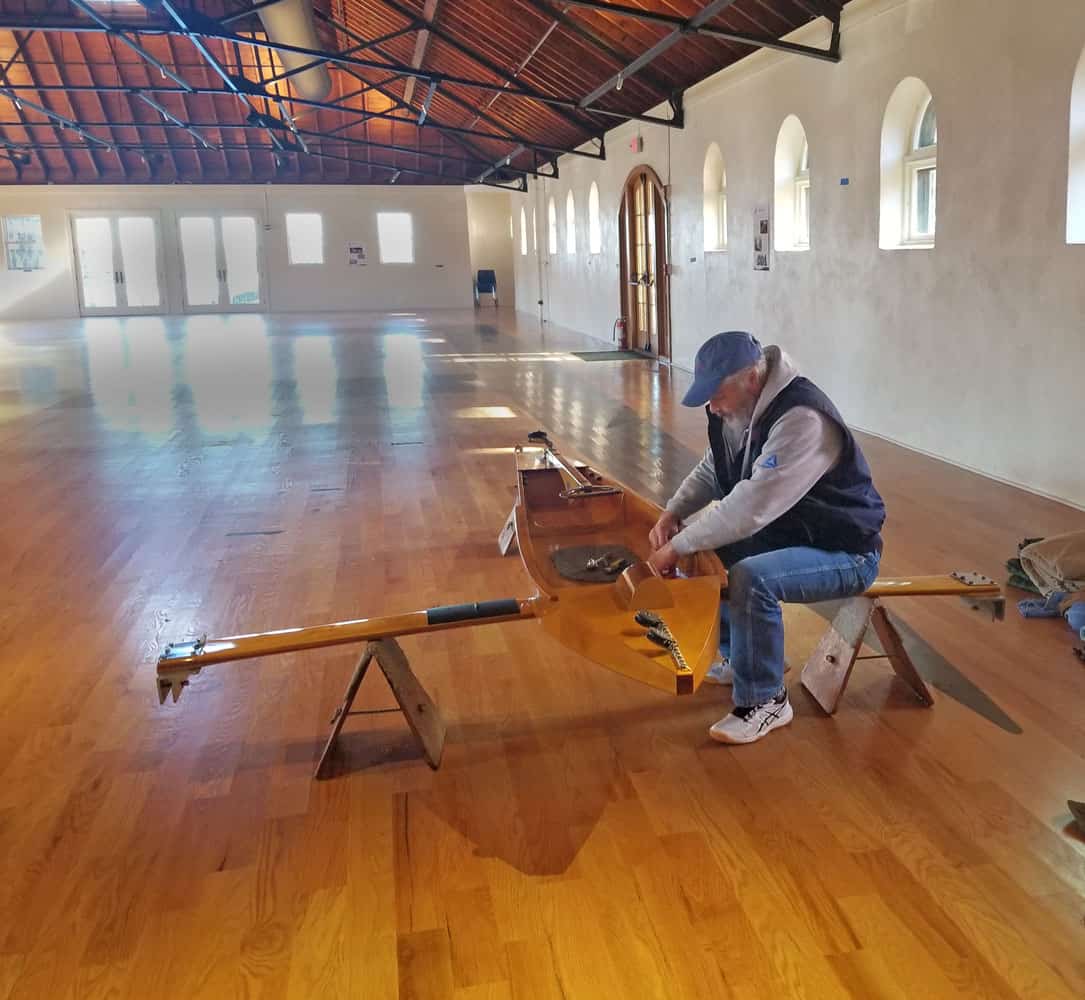
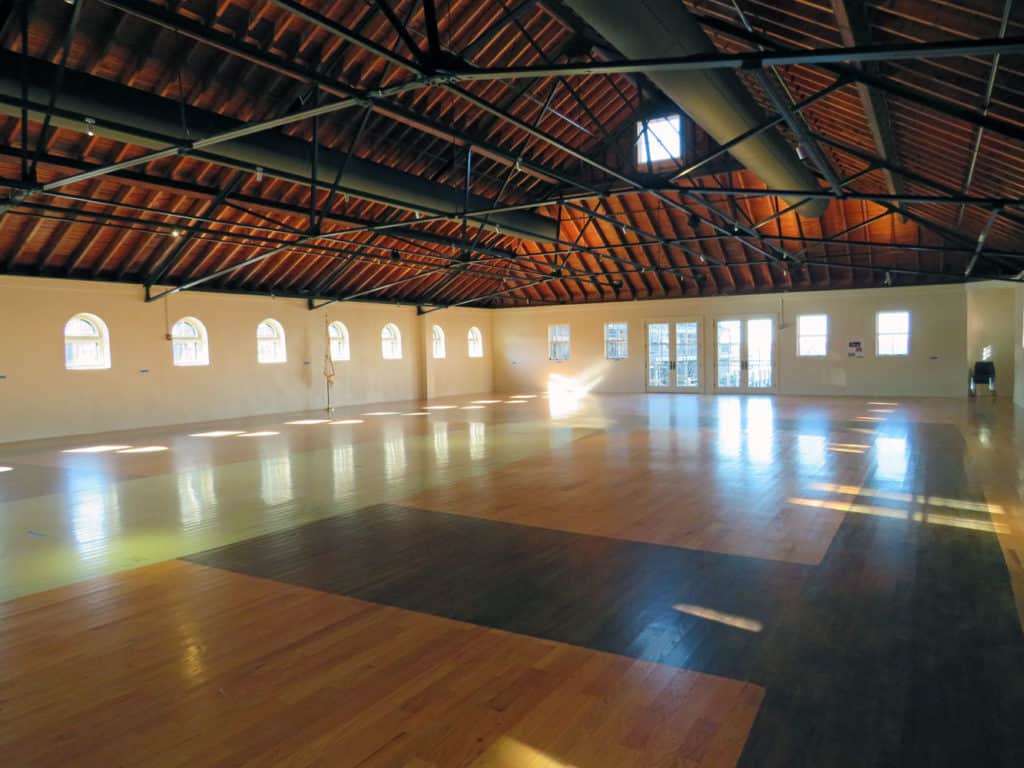
The sailing community’s full recognition of the sport of ice yachting has culminated with the inclusion of an iceboat in the new NSHOF museum in Newport, Rhode Island.
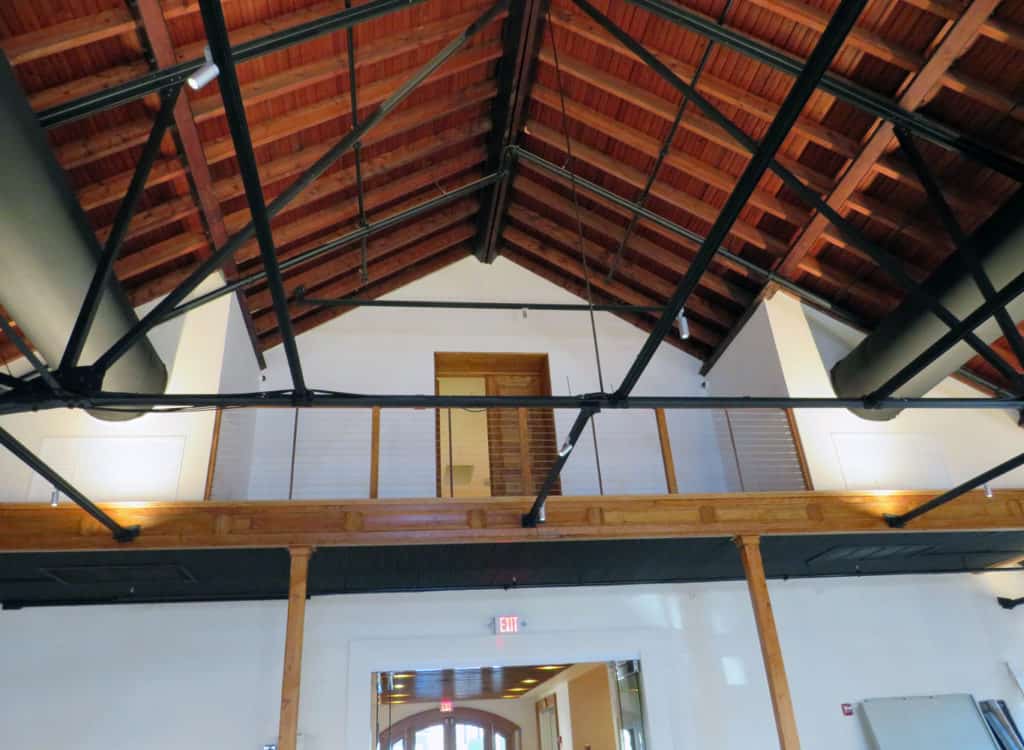
When visitors enter the impressive interactive exhibition hall, they will notice six boats hanging overhead from the exposed wooden rafters of the historic former armory. One of those six is an iceboat representing our community and those who live to “Think Ice.”
The NSHOF asked Four Lakes Ice Yacht Club Nite sailor Don Sanford (the driving force behind Bill Mattison’s induction), myself, and others for an iceboat. The museum had hoped to hang a Class A Skeeter, but the wide plank would have taken up too much space. They chose one that would fit – the most popular iceboat globally, a DN.
Peter Harken asked that the boat not be a “fixer-upper” but a fully fitted racing boat. The NSHOF accepted Four Lakes Ice Yacht Club member Doug Kolner’s offer to donate his complete modern DN.
The DNs natural wood hull and plank, built in a small garage in Monona, Wisconsin, are true to the roots of the DN’s humble beginnings at the Detroit News hobby shop in the 1930s. Doug built the boat using standard DN plans, and it symbolizes all the iceboat builders who enjoy kicking up some dust and mixing epoxy in their garage shops.
Current members of the NSHOF’s influence is evident in the fact that the boat was built using Gougeon brothers epoxy and Harken brothers fittings technology. Doug recognized NSHOF member Bill Mattison and Green Lake Ice Yacht Club’s Joe Norton as the builders who had influenced his iceboat building know-how.
“The design, construction, and handling of an ice boat is an art rather than an exact science.” Herbert L. Stone
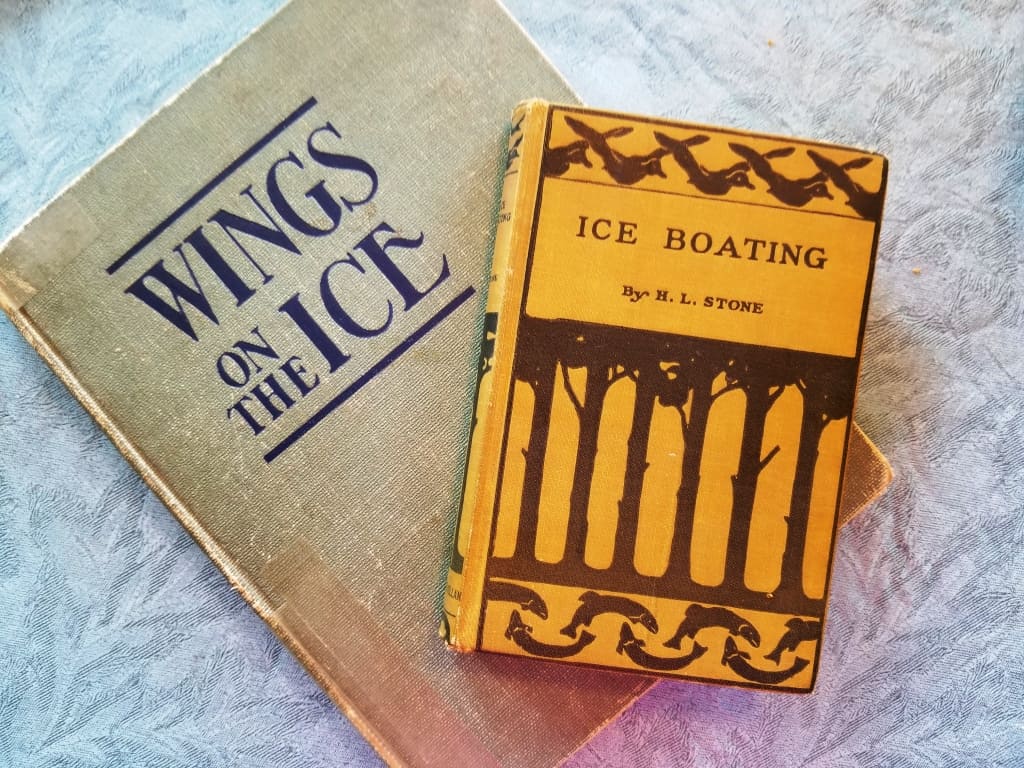
Yachting Magazine editor Herbert L Stone, editor of the first ice sailing book in the United States, is being inducted into the National Sailing Hall of Fame. Stone edited the book “Ice Boating” in 1913 and also wrote the forward to “Wings On the Ice” (published in 1938), one of the best books on the subject ever written.
I can find no evidence that Stone ever owned an iceboat but he had a tremendous influence on the sport by helping to popularizing it through articles in Yachting Magazine. Stone played a big part in reviving the Ice Yacht Challenge Pennant (IYCP) when he encouraged the IYCP trustees of the New Hamburgh Ice Yacht Club to pass on the trusteeship to the Eastern Ice Yachting Association.
Read Ray Ruge’s 1950 article about the revival of the IYCP published in Yachting World here.
Stone’s forward in “Wings On the Ice”, written 81 years ago, still rings true today.
Perhaps one of the chief charms of ice boating is the fact that the implements with which the sport is played, just as in the case of sailing yachts, have not been reduced to a fixed, static quantity. The design, construction, and handling of an ice boat is an art rather than an exact science. There is still room for the play of new ideas, for the expression of individual talent, for the exercise of skill, knowledge, and ingenuity. Herbert L. Stone Excerpt of forward to Winds on The Ice, Frederic M. Gardiner
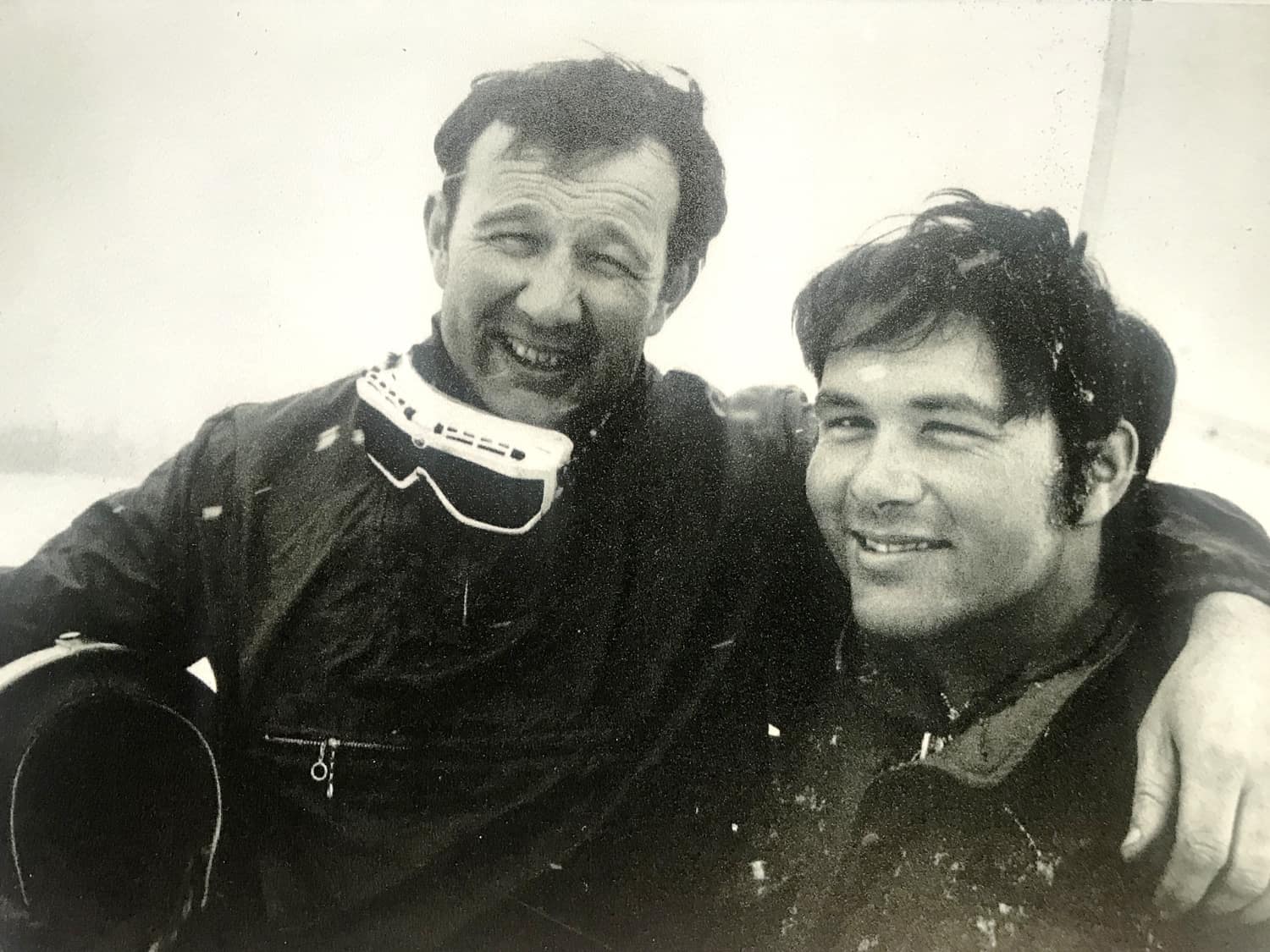
Doing what they loved, brothers Jan and Meade Gougeon during a day of ice sailing.
The moon walk wasn’t the only technological accomplishment in 1969, it was 50 years ago when two brothers in Michigan figured out a better way to build iceboats and developed two-part epoxy. I remember the transition from Weldwood to WEST SYSTEMS epoxy. The excess Weldwood would form hard amber droplets under my dad’s long iceboat building bench. As a kid, they were kind of fun to play with until one day, those little pieces were gone having been replaced by two-part epoxy that didn’t drip. “Gougeon” is used in every class of iceboat build – from the biggest stern-steerers to youth Ice Optimists.
Read more about the 50th anniversary celebration over at the IDNIYRA website.